
How to Manage Change Without a Change Manager
Most change in your organisation will never get a change manager.
The new rostering system. The updated compliance process. The restructure of a single team. The legislative reform that shifts how frontline staff work.
These changes have smaller budgets than the big transformation programs. Their impact on people can be just as large. And they’re usually delivered by whoever leads the team.
That means operations managers, team leaders, general managers and executives. They already have full plates, and now they’re accountable for change as well.
If that’s you, this article is for you. It covers five practical ways to deliver change well without a dedicated change team.
Why so much change now happens without a change team
Over the last few years, four workplace pressures have become hard to ignore:
Continuous change. One change barely beds down before the next arrives.
Deeper uncertainty. Plans have a shorter shelf life.
Leaner resources. Fewer people, and change budgets that go to the largest programs.
A push for agility. Organisations want to move faster and adapt as they go.
Put those together and the maths is simple. There aren’t enough change practitioners to cover every change, so most change is left to leaders. Every change affects people in some way, however small or technical it looks on paper.
The cost of getting it wrong
When busy leaders deliver change without support, the pattern is familiar. The change gets announced in an email. People find out late. Questions go unanswered. Workarounds appear. Adoption stalls, and the benefits the business case promised never show up.
That’s the cost of bad change. It shows up in lost productivity, rework, disengaged teams and change fatigue. It also makes the next change harder, because people remember how the last one went.
The good news is that avoiding most of that cost doesn’t take a change practitioner. It takes a leader with a few simple tools who knows when to use them.
5 ways to deliver change without a dedicated change team
1. Right-size your change effort
Not every change needs a 40-page change plan. A small process tweak and a new enterprise system shouldn’t get the same treatment.
Ask three questions early:
- Who is affected, and how much will their day-to-day work change?
- What happens if people don’t adopt it?
- What’s the least we can do that still gets people ready?
Matching the effort to the impact saves time and money. It also saves your team’s goodwill.
2. Start earlier than feels necessary
Many leaders tell us they’re too busy to plan for change. We understand why. But a little planning early saves a lot of grief later.
Twenty minutes working through who’s affected and what they need to know is cheaper than weeks of fixing confusion after go-live.
3. Get clear on roles and accountabilities
When there’s no change manager, it’s easy to assume someone else has it covered. Often nobody does.
Be explicit about three things:
- Who is sponsoring the change and making the decisions?
- Who is leading the people side day to day?
- What do team members need to do, and by when?
Clear roles are one of the simplest ways to stop a change from drifting.
4. Engage people instead of just telling them
An email announcement tells people something has changed. It won’t help them understand the change, adapt to it or raise concerns.
Good engagement doesn’t need to be elaborate. Try a short team conversation, a chance to ask questions, or a quick check-in two weeks after go-live to see what’s working. These small moves build understanding and surface problems while they’re still easy to fix.
At ACLI we call this continuous engagement. It’s one of the three agile change capabilities that fit any methodology, alongside data-informed decision making and visual, transparent communication.
5. Use a few simple tools well
You don’t need to learn a full change methodology to lead change well. A handful of simple tools will help you:
- a change canvas for the overview
- a high level change impact review
- a high level change readiness check list
- a change communication plan on a page
The key is to use tools that make the work lighter instead of heavier. If a tool adds to your workload, it won’t get used.
Mindset matters as much as tools
Tools help, but how you think about change matters just as much.
Leaders who see change as a one-off event get caught out when the next one arrives. Leaders who expect change to be continuous plan for it, stay curious about how people are responding, and adjust as they go.
Self-awareness is a powerful thing when you’re leading, delivering or sponsoring change. Small shifts in mindset can make a big difference to how your team experiences it.
When your leaders need more support
If your organisation runs a lot of change without a dedicated change team, it’s worth building this capability across your leaders instead of leaving each of them to work it out alone.
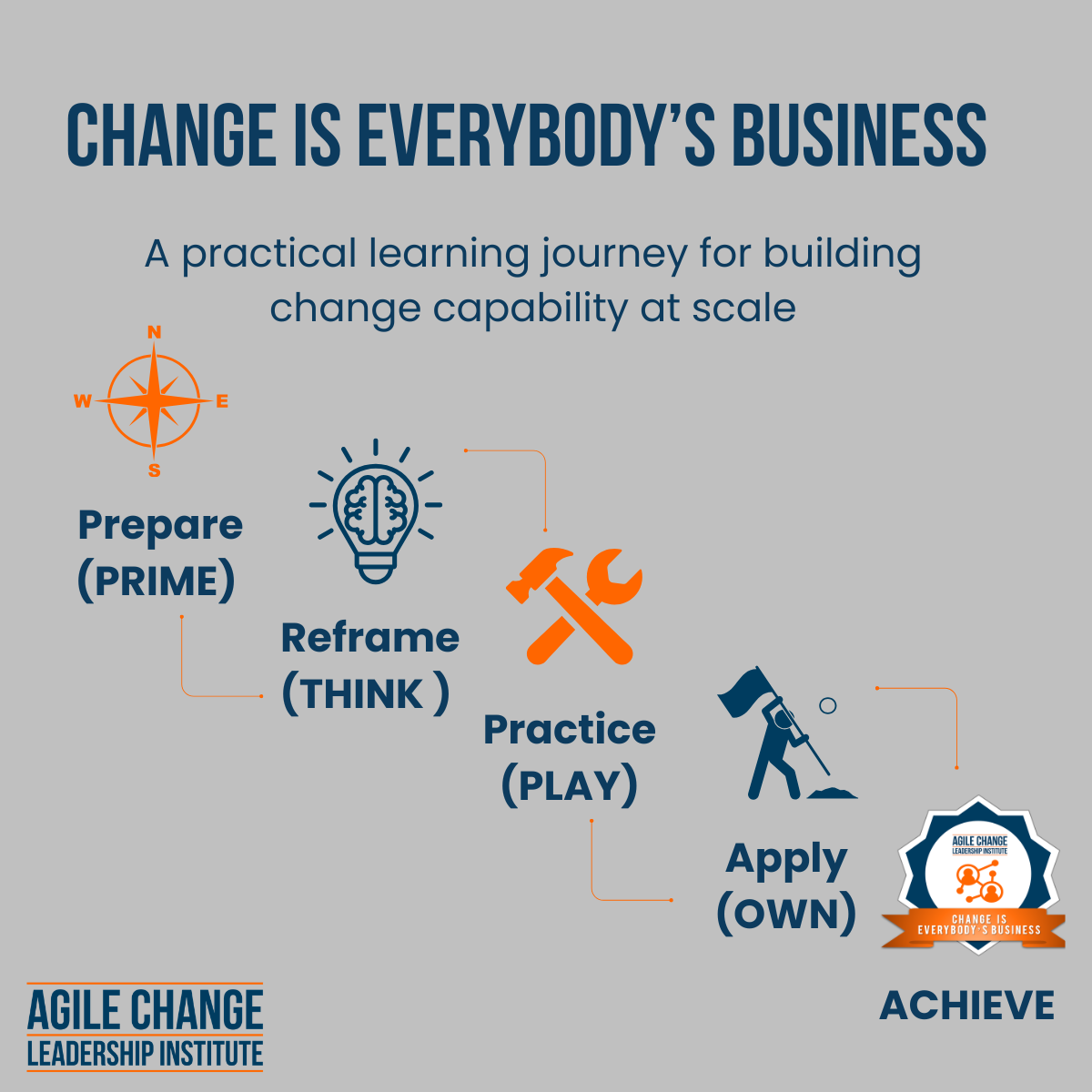
That’s why we designed Change is Everybody’s Business, an enterprise learning program for leaders who carry change on top of their day job. It combines four hours of live learning with online study. Participants:
- work through five mindset shifts that support continuous change and agility
- try out five simple change tools in a guided, real-time session
- get clear on their role and accountabilities in change
- learn ways to engage people that go beyond sending an email
They then complete their learning online and earn a digital credential.
The program is methodology agnostic, so it works alongside any change or project management training your people already have.
Past participants tell us they leave feeling more confident, more capable and calmer about the change ahead. Many start using the tools with their teams during the breaks.
If change is a bigger part of your role, the Agile Change Manager Certificate goes deeper, with 50+ agile change practices and 50+ templates.
Frequently asked questions
Do small changes need change management?
Yes, but scaled to the size of the change. A small change might only need a clear message, a team conversation and a check-in afterwards. What matters is thinking about the people side early.
Who is responsible for change management when there’s no change manager?
Usually the leader of the affected team, supported by a sponsor who owns the decision. Agree on these roles at the start so nothing falls through the gaps.
Can managers lead change without formal change management training?
Many do, and with a few simple tools and a clear view of their role, they can do it well. Short, practical training helps leaders avoid common mistakes without turning them into full-time change practitioners.
Want to build change capability across your leaders? Talk to us about Change is Everybody’s Business.
Or check out how we did this with 400 managers at NBN!