
How to communicate change: a practical guide
The short answer:
To communicate change well, start with the purpose of your communication, then combine clear one-way information with real two-way conversation. Keep messages simple, regular and visual. Tailor them to the people affected. Adjust your approach as the change moves from idea to embedded practice. Listen closely to the informal conversations people are having about the change, because that’s where they make sense of it.
The longer version:
Communicating change is one of the most important parts of leading change, and one of the most underestimated. For many organisations, change communication still means fact sheets, FAQs, roadshows and manager talking points. These have their place. Used alone, they rarely shift how people think, feel or act.
This guide covers what change communication involves and how to do it well.
What is change communication?
Change communication is more than a tool for announcing a new system, structure or set of values. Organisational change happens through communication: the announcements, the conversations and the stories people tell each other along the way.
Change communication flows in three ways.
Monologic communication
This is a form of change communication that is top-down, one-way and informational. Announcements, updates, fact sheets and FAQs. It aims for one voice and a shared understanding, and the power sits with those making decisions about the change.
Dialogic communication
This represents change communication that is is two-way and constructive. Relationships matter, different perspectives matter, and the frontline employee has a voice alongside the CEO. Dialogue creates new meaning, ideas and ways of working from the conversations themselves.
Background talk
This is the informal communication of change: the grapevine, the corridor conversations, the chat after the meeting. This is where people make sense of what’s happening to them. It often carries more weight than the formal narrative, and it’s a reliable barometer of how receptive people are to the change.
Dr Jen Frahm once explained her research on change communication to a water engineer, who summed it up neatly: “So it’s a pipeline. And the sense-making is the backwash.” When there isn’t enough monologic or dialogic communication flowing, people fill the gaps with assumptions, rumour, resistance or silence. Sense-making will happen either way. The question is whether you’re supporting it.
How to communicate change in eight steps
1. Start with the purpose of your communication
Before planning channels or messages, ask: What is this communication for?
One useful lens is the tension between change and stability. Some communication creates stability: it reassures, educates and clarifies details when people are uncertain. Fact sheets, FAQs and talking points do this well. Other communication creates further change: it invites ideas, surfaces concerns and lets people shape what happens next. Forums, collaborative platforms and a culture that values listening do this.
Both are needed, at different times. Problems start when an organisation tries to create change using only stability tools.
Then get specific. For each audience, decide what you want them to know, feel and do. If a message doesn’t serve one of those three, it probably doesn’t need to be sent.
2. Understand the history
Change communication never happens in a vacuum. The organisation’s history shapes how every message is heard: past restructures, broken promises, successful changes, the level of trust in leadership.
A team that has been through three restructures in four years will read “exciting new operating model” very differently from a team that hasn’t. Find out what has come before, and acknowledge it.
3. Communicate differently at each stage of the change
Change communication isn’t one event. Cheney, Christensen, Zorn and Ganesh (2004) describe four change-related communication activities, each with a different job:
- Formulation: shaping what the change could be. Communication here is exploratory, and it includes experimentation, ideation and testing.
- Implementation: introducing the change. This is the familiar territory of communication plans. It’s also contested ground, where resistance and negotiation happen and where networks of influencers matter.
- Institutionalisation: embedding the change. Communication here celebrates progress, reinforces new behaviours and makes the change part of how things are done.
- Dissemination: sharing the experience and the learning. For organisations in continuous change, reflecting on the last change before starting the next is essential.
Match your communication to the stage. A polished launch campaign during formulation shuts down the conversation you need. A single announcement during institutionalisation leaves the change to fade.
4. Balance the broadcast with conversation
Most change communication plans are heavy on broadcast and light on dialogue. Information alone rarely changes behaviour. Conversation helps people test what they’ve heard, raise concerns and take ownership.
For every major announcement, plan the conversation that follows it: team huddles, leader-led discussions, open Q&A sessions or peer conversations.
Dialogue takes capability. Research by Bokeno and Gantt (2000) describes dialogic communication as distinctly different from usual management communication. It calls for real care and respect, reflective discussion and authentic speech. It asks leaders to listen, show empathy, respect difference and set aside status and ego. Building that capability in leaders is part of communicating change well.
5. Keep it simple, small and regular
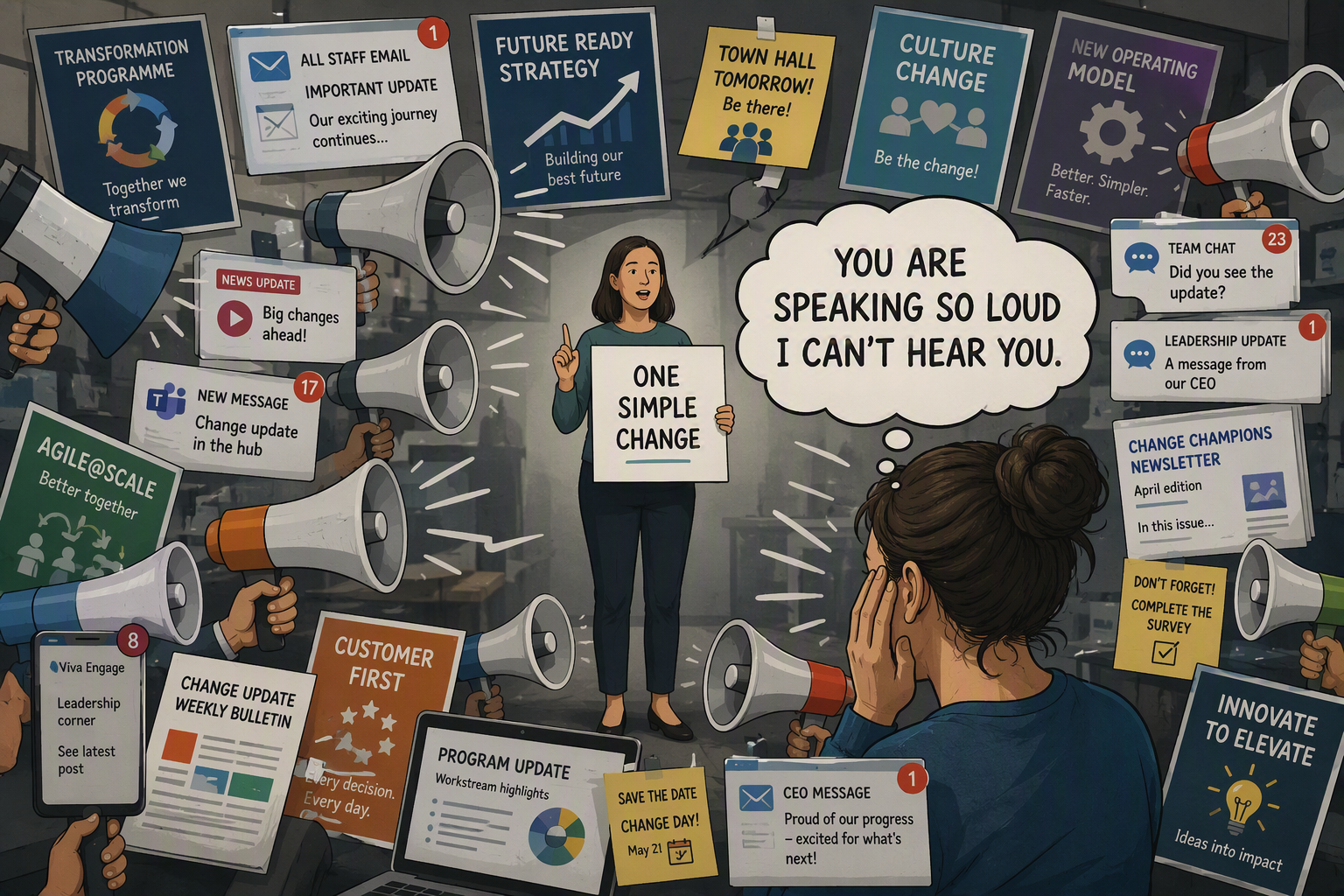
Employees are already overloaded with information, a problem often called infobesity. During change, it’s tempting to communicate every detail. Important messages then get lost.
- Simplify: short sentences, clear headings, one purpose per message.
- Go small: use micro-communications such as two-minute videos, quick updates in Teams or Slack, and single-slide briefings. Avoid long emails.
- Find a rhythm: a predictable cadence reduces uncertainty, because people know when they’ll hear more.
6. Tell the story and make it visual
Facts inform. Stories help people make meaning. A clear, honest story about why the change is happening, what it means for people and where it’s heading gives people something to make sense of the change with. Name what’s being lost as well as what’s being gained, and use voices your audience trusts, such as a pilot team or a respected peer.
Pair the story with visuals. Roadmaps, simple diagrams and progress dashboards make change easier to understand and remember. They also build trust, because people can see progress for themselves.
7. Design for your audiences
One-size-fits-all communication rarely works. Leaders, frontline staff, technical teams and customer-facing teams each have different concerns, pressures and preferred channels. Personas help you design for real people rather than a generic “employee”.
AI and analytics now make tailored communication possible at scale. Use them with care. Personalisation should help people understand the change. Be open with people about how their data is used.
8. Listen to the background talk
The informal conversation about a change is your best early-warning system. Stay close to it through pulse checks, conversations with informal influencers, team retrospectives and honest feedback loops.
When the background talk drifts from the formal story, don’t simply repeat the message louder. Find out what people are making of the change and respond to that.
Common mistakes when communicating change
- Treating communication as a launch event rather than an ongoing process
- Relying only on one-way channels such as email, FAQs and intranet posts
- Ignoring the organisation’s change history
- Over-communicating detail while under-communicating purpose
- Sending the same message to every audience
- Treating the grapevine as noise rather than information
Frequently asked questions
What are the key principles of change communication?
Be clear about purpose. Balance one-way information with two-way dialogue. Keep messages simple and regular. Tell an honest story. Tailor to your audiences. Listen to how people are making sense of the change.
What is the difference between monologic and dialogic communication?
Monologic communication is one-way and informational: announcements, updates and FAQs. Dialogic communication is two-way and collaborative, creating shared meaning through conversation. Effective change communication uses both.
Who should communicate change?
Senior leaders set direction and explain why the change is happening. People’s direct managers are usually the most trusted source for what it means for them. Informal influencers and peers carry weight in the background conversation. A good plan uses all three.
How often should you communicate during change?
Little and often. A predictable rhythm of short updates, combined with regular opportunities for conversation, works better than infrequent, lengthy announcements.
How do you communicate change to employees who are resistant?
Start by listening. Resistance often signals unanswered questions, past experience or a real concern about loss. Create space for dialogue, acknowledge what’s being lost, and involve people in shaping how the change is implemented.
Further reading and development
For a deeper look at the principles and tools of modern change communication, see Dr Jen Frahm’s Change. Communication.
The Agile Change Manager Certificate program also offers upskilling in change communication.
References:
Bokeno, R. M., & Gantt, V. W. (2000). Dialogic mentoring: Core relationships for organizational learning. Management Communication Quarterly, 14(2).
Cheney, G., Christensen, L. T., Zorn, T. E., & Ganesh, S. (2004). Organizational Communication in an Age of Globalization. Waveland Press.