Have you ever looked at your professional development options and wondered:
Where does this actually lead?
At the Agile Change Leadership Institute, we’ve always believed that learning should
feel connected, not fragmented. That’s why we talk about learning pathways, not
just courses.
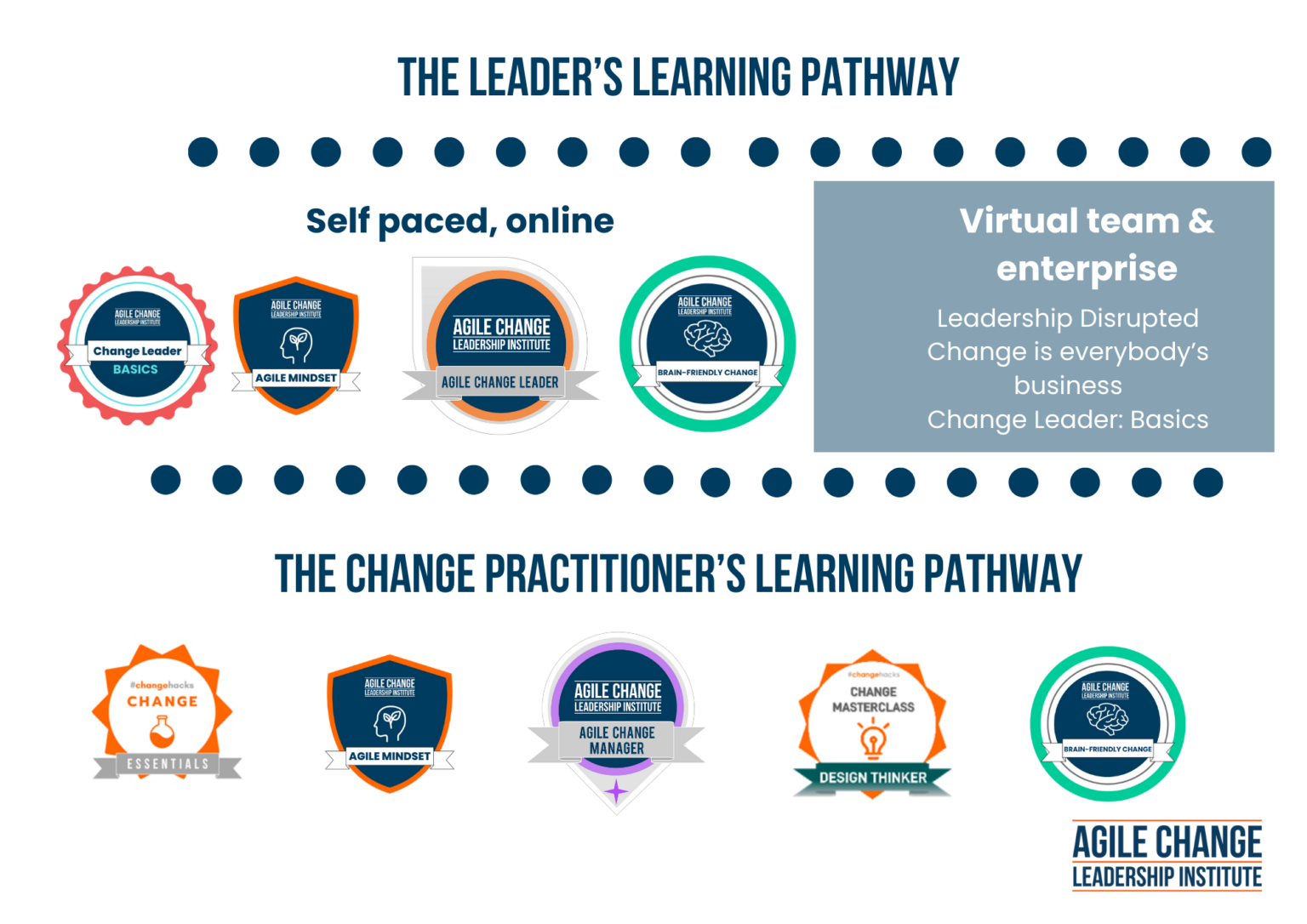
Today, our ecosystem is organised around two complementary learning
pathways:
- The Leader’s Learning Pathway – for those leading change
- The Change Practitioner’s Learning Pathway – for those delivering
change
They overlap. People move between them. But they reflect two different roles people
play in change — and different capability needs at different moments.
Two Pathways, One Shared Goal
Both pathways ultimately support the same outcome – more confident, capable, and human change.
Where they differ is where the focus sits.
- Leaders need to make sense of uncertainty, set direction, sponsor change,
and role-model new ways of working. - Practitioners need the tools, judgement and adaptability to design, deliver
and sustain change in complex environments.
Our learning pathways help people see how capability builds in each of these roles
— and where they might want to go next.
The Leader’s Learning Pathway: Leading Change
The Leader’s Learning Pathway is designed for people who are:
- Leading teams through change
- Sponsoring or shaping transformation
- Navigating disruption where “change is everybody’s business”
For many leaders, the starting point is Change Leader: Basics — a short,
accessible entry point that builds shared language, confidence and awareness
without requiring a deep background in change.
From there, leaders often move into:
- Agile Mindset, to reframe how they think about complexity and uncertainty
- Agile Change Leadership Certificate, where learning deepens through real workplace experiments and reflection
This pathway is about how you show up as a leader in change, not just what you
say or approve.
The Change Practitioner’s Learning Pathway: Delivering Change
The Change Practitioner’s Learning Pathway supports people whose role is to
design and deliver change.
It’s for those who are:
- New to change and needing the essentials
- Building or modernising their change toolkit
- Working in fast-moving, high-change environments
Many practitioners begin with Change Essentials or Agile Mindset — practical,
time-efficient courses that establish strong foundations.
From there, capability builds through:
- Agile Change Management Certificate, with a strong focus on tools, techniques and
delivery at speed with lean resourcing - Where Design Thinking Meets Change Management, for more participatory, human-centred change design
This pathway supports the shift from doing change by the book to designing change
with intent and adaptability.
Going Deeper: When Experience Raises New Questions
Across both pathways, there comes a point where experience leads to deeper
questions.
Why are people exhausted?
Why does resistance show up the way it does?
How do we design change that feels safer and more sustainable?
This is where Brain-Friendly Change often fits.
It’s not an entry-level course — it’s a depth course, designed for experienced
leaders and practitioners who want stronger behavioural insight and more humane
change design.
Rather than adding more tools, it adds understanding.
Not Linear. Not One-Size-Fits-All.
What our learning pathway images make visible is something we’ve always known:
There is no single, linear route to change capability. Some people start as practitioners and grow into leadership.
Some leaders step into delivery roles.
Some move between both pathways over time.
Our pathways are designed to:
- Help you identify where you are now
- Show how capability builds
- Give you choice, autonomy and clarity about what’s next
And yes — your brain will appreciate that.
Designed for Real Work, Not Just Learning
Across both pathways, one thing stays constant: learning by doing.
Our courses are underpinned by:
- Micro-learning
- Practical application
- Workplace experiments
- Reflection and sense-making
Because change capability isn’t built in theory — it’s built in context.
If you’d like to explore the full suite of courses and see how they fit across both
pathways, you can view them all via our Teachable school.
Whether you’re leading change, delivering change, or doing a bit of both —
there’s a pathway designed to meet you where you are, and support where you’re
heading next.