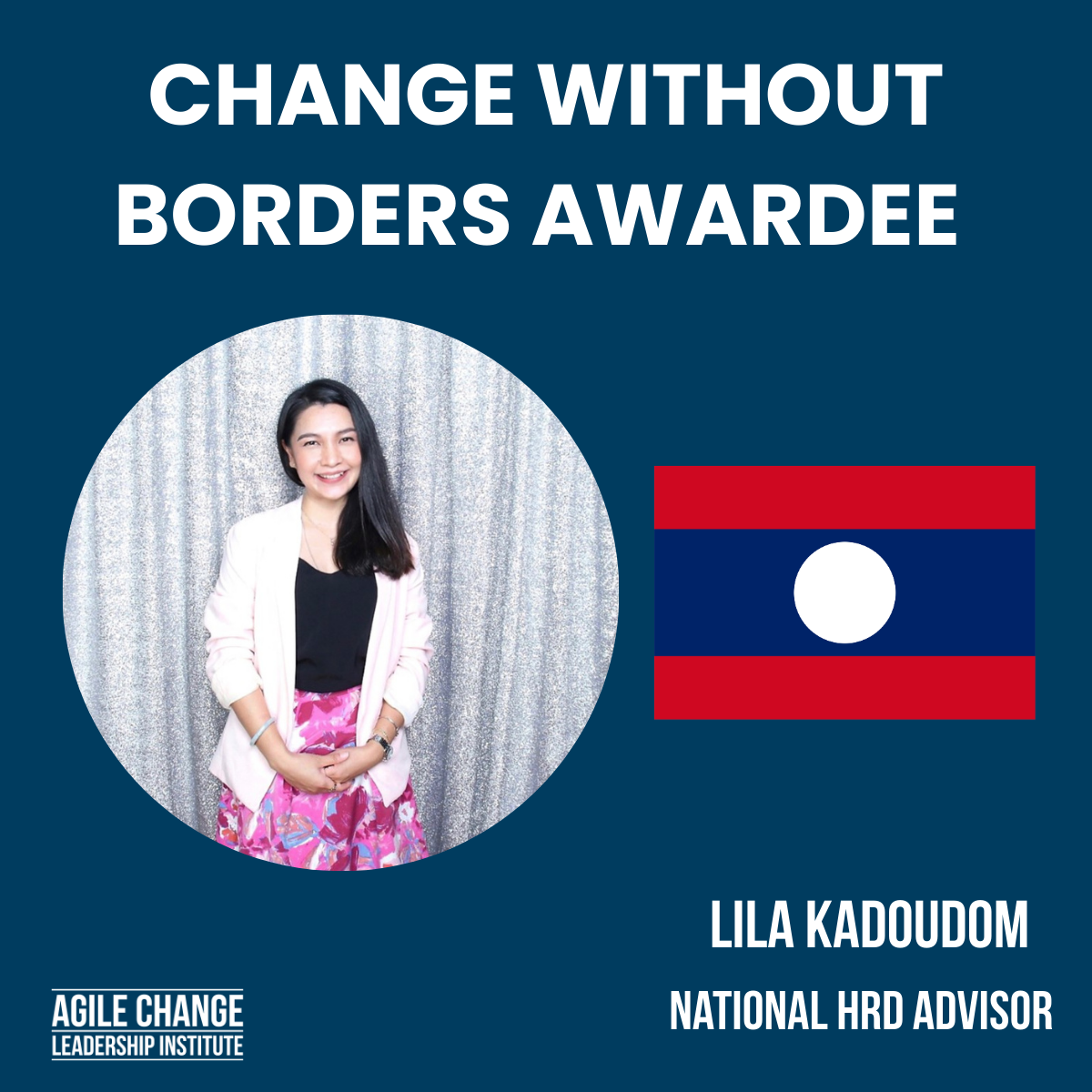
Recently, I had the opportunity to complete an online course on Agile Change Management, generously supported by a scholarship from the Agile Change Leadership Institute. As a Change Management Advisor at the Ministry of Finance (MOF) in Laos, I constantly face challenges of guiding people and organizations through complex transitions. This course gave me fresh perspectives and practical tools that I am excited to bring into my current work.
Before joining the course, my approach to managing change was mostly traditional. I focused on planning step by step, making sure processes were clear, and trying to control outcomes as much as possible. While this method has its strengths, I often found that change is rarely predictable. Projects can shift quickly, stakeholders can have new concerns, and unexpected challenges can arise. The agile approach helped me to see that managing change is not only about control, but also about flexibility, adaptability, and continuous engagement with people.
The course introduced me to practical tools that I can now apply in my projects at MOF. For example, prioritization techniques will allow me to identify what matters most to stakeholders at different times. Stakeholder mapping will help me understand their influence and interests in a clearer way. Short-cycle planning will make it possible to deliver value step by step, instead of waiting until everything is perfect. These tools are not only effective, but they also make change feel less overwhelming for the people involved.
Another highlight of the course was the engaging and clear instruction. Even though it was online, the sessions were fun, interactive, and easy to follow. The examples used by the instructors made the theory come alive, showing how agile principles can be applied in real situations.
I believe these new perspectives will strengthen my work as a Change Management Advisor. They will allow me to guide change in a way that is more responsive to people, more adaptable to uncertainty, and more effective in achieving results. I am grateful for the opportunity and look forward to incorporating this learning into ongoing and future projects at MOF in Laos.