Dr. Jen Frahm:
Hello, everybody. Welcome back to another edition of Conversations of Agile Change. Today, I’m really
excited about this conversation. I have with us the fabulous Allie Hartman of the Change Curiosity Lab.
Now, Allie is going to be joining us in January 2026 to do a webinar for us on the topic of the moment,
AI and agile change. And I thought it’d be really cool to have a bit of a chat in advance, get to know her,
find out a little bit more about her thinking, and particularly what’s grabbed our attention and why we’re
really keen to bring it to you in a webinar. Allie, welcome to Conversations of Agile Change.
Allie Hartman:
Thank you so much for having me.
Dr. Jen Frahm:
Oh, pleasure, pleasure. Obviously, we’re going to speak about AI, but before we do, let’s speak about the
human and tell us, how did you get into change management, change leadership, change practitioner?
What was it that brought you to this moment where you are sitting here and chatting to us?
Allie Hartman:
Awesome. So, when I was growing up, I always thought I was going to be an engineer. I had that
analytical mind. I like to take things apart. I like to figure things out, and I was set on that. And then
midway through college, my university, I decided, nope, that wasn’t it. That’s not it.
So, I pivoted to psychology. And so I always think I have that kind of technical analytical mind and also
the human people side, which I think is great and where I’ve spent most of my career in technology
change management. And so after graduation, I kept learning, I kept getting degrees. I’ve got a bunch of
degrees and certifications.
And at the time it felt a little disjointed and people were probably questioning, like what are you doing?
But once I figured out that I wanted to go into consulting at a big technology firm, I, through some
networking, landed on a change management team working with one of our state clients, and I said, “This
is it.”
All the pieces connected. I’ve got the technology side, I’ve got the psychology, the behavior change side.
And I knew that was it. I could check everything else off the box and say, “That wasn’t it, but here we
are.” And that was, gosh, 11, 12, 13 something years ago. And I’ve just continued to grow and do
different roles within the change space.
And I really just love being able to connect and be the translator really from that technology side into the
people side. Because of course, without any humans being brought along the journey, something’s just not
going to be adopted. So, that is how I’ve gone through a little bit of my journey.
Dr. Jen Frahm:
Yeah, fantastic. I think one of the things that has stood out to us is your generosity. Obviously, you are an
avid lifelong learner. You can really pick that up.
So, we see you as quite curious and generous in your role as a change leader, and so I’m thinking of a lot
of the work that you share on LinkedIn is really quite helpful to people. You’re heavily involved with
ACMP as well. I’m curious about where does this passion for community and learning come from? How
did that… From someone who thought they were going into engineering to actually this person who is
constantly giving out, tell me a little bit more about that.
Allie Hartman:
Sure. And I think that’s a little bit how my brain just works. I love innovating. I love being curious. I think
that goes along really well with being a lifelong learner and always asking those questions, “Well, why
not this? What if we did it this way? How else could we do something?”
And luckily, honestly, I’ve had wonderful, supportive leaders and sponsors that have been on teams with
me who have helped me in my confidence to be able to say, “No, actually, you are an expert in this field.”
I remember only two or three years ago, I was in my first data strategy role and I was looking for the
intersection of data and change management.
And I kept being like, “There’s no one on LinkedIn talking about this. This can’t be the only one.” And my
boss would say, “Yes, you are the only one looking at this. No one else has time to write on LinkedIn
about this, maybe if they’re dabbling, but really you are the expert in this thing.” And I’m like, “No, that
cannot be. I’m not the expert in this.”
And his confidence in me broke down some of those imposter syndrome ideas in my own head of being
like, “No, I can’t be the expert.” Yeah, I have some experience and it’s great. And having a few of those
leaders, those mentors, those sponsors, really speaking up for me at the tables that I’m not sitting at, has
really given me the confidence to say, “No, actually I do know what I’m talking about. I have a lot of
degrees and certifications and experience leading teams, leading transformation and leading change.”
And so, I just love to be able to share that with people. And now that I have more of the confidence of
saying, “Yes, I know those things, but I would also like you to have those things.” And so I love being
able to share that with people, make things, especially in the world of AI and that fear factor, and just
having that tangible, quick, easy prompt or that example or that use case for people to grab and say,
“Okay, that’s maybe not as scary. I can copy-paste at least to get started.”
And so I try to make everything super tangible and actionable and valuable for different change
practitioners and non-change practitioners and leaders, so that they can really help curate their own story
in what that looks like. And if I can help contribute to some of that learning and others, I’m super happy
about it. So yeah, I love to share.
Dr. Jen Frahm:
And I think that’s what really grabbed our eye. And we’ve shared a couple of your pieces through our
Sprint newsletter, because it is the accessibility of it more so than the theory or the knowledge. It’s
actually really practical, which we’re huge fans of. Can we just backtrack a little bit? You talked about
your certifications and all of your formal skills and training.
So, you are an Agile Change Leadership Institute alumni. You did our Agile Change Manager Certificate.
Allie Hartman:
I am.
Dr. Jen Frahm:
How do you see the relationship between formal skills development and informal skills development? So
things that you pick up on the job, and because I am mindful of… We talk about the industrial certification
complex, that everybody feels that they need a certification to be able to progress.
And as much as we’ve got skin in the game in this space, we would also argue that, no, you can progress
without doing formal training. And I’m curious what you think is the balance or how that plays out
together.
Allie Hartman:
Yeah. And I get this question a lot too, because again, I have a lot of degrees. I’ve been to school quite a
bit and certifications that I’ve done on my own. And I think there’s incredible value, especially starting
out, to have some of those foundational pieces to learn, especially for change management, what is
change management, what activities go in that role, what are the different types of roles you can have?
I think that foundational piece is super important to have, especially when you’re starting out. And then I
think with that though, probably not shocking to anyone is that really that on the job learning and
shadowing or testing things out with practitioners that have been in the field for a while is so important.
Because even if you read the best textbooks and methodologies and change management, there’s always
just so much you have to learn on the fly. And sometimes you get thrown into the deep end or drinking
from a fire hose, all of those different analogies, to understand.
But I think I always tell people, “What’s your end goal a little bit of, do you need that thing on your
resume? Are you going to be looking for jobs soon? Do you want really that stamp of approval from an
authority in change management to say, ‘Yes, I know these things. Yes, I am continuously learning. I am
practicing my skills.’ Versus a one and done, ‘Here’s the course I took, check the box.’.
“And to have that experience to back it up too, or are you just trying to be a lifelong learner? And you
don’t really need the credential per se, but you have a thirst for learning and you want to try all these
methodologies and get deep learning in maybe one methodology or get more of the breadth.”
And so I always kind of say, “What’s the value?” And of course, there’s a cost for either side. I could be
good-looking on your resume and that could boost you in a job market, but maybe it’s cost prohibitive at
the moment. And there’s so many resources like LinkedIn or Substack, where you can get a lot of those
kind of free things, YouTube, where you can get some of that learning, even just mentoring and
shadowing from colleagues or meeting with them regularly to say, “Hey, I’m working through this
scenario, help me work through it,” is so valuable that I would never discount it or say that you have to
get all of these certifications.
I think in the world we’re in today where education, [inaudible 00:11:12] in the US is changing quite
rapidly, and there’s very cost prohibitive nature to it. So, I think if you can find those opportunities, if you
have the chance and the opportunity to take a course, and learn, that’s wonderful and that will always help
you.
That’s never going to go against you at all. But I think pairing it with the experience and the mentorship is
so valuable to get really that on the job learning. And you can do that in a lot of informal ways.
Dr. Jen Frahm:
Yeah. No, I think that probably sits with us because I think one of the things that we’re always really
conscious of is people find us through various means and methods. And we always want to be able… The
reason why we do post
We want people… We don’t want cost to be a barrier if you really need it. Absolutely, our courses will
take you to the next level, and can’t replicate what we’ve got on YouTube, but there shouldn’t be a barrier to… If you are motivated enough, and I think that’s probably the piece here that bridges what we’re both
saying here, is that there needs to be some level of intrinsic motivation. If you are not motivated to learn
and apply, it doesn’t matter how many courses you do or certifications you do, it won’t be a value to you.
So yeah, interesting
Allie Hartman:
I think also being a part of a newer profession with the official title of change management, it’s only been
around officially for a few decades probably. We want more people to understand what change
management is. We want to grow change leaders, not just with the title of change management, but with
understanding transformation and how culture at your organization shapes everything that you do.
And so I always see it too as a, “Hey, I want everyone to have this knowledge so that they’re better
prepared to even have coaching conversations with their teammates or have a conversation with a leader.”
And so I always think that it’s great to share the wealth.
Of course, like you said, having the deeper level certifications is wonderful to get really the true
understanding, but at least for that kind of high level, “Hey, here’s what we offer. Here are all these things
that you can just sign up for our newsletter, read our LinkedIn, read our blogs, watch our YouTube.” All
of those sort of things are contributing to a better knowledge of the general public around us.
Dr. Jen Frahm:
The one thing I do know is we will never be enough, right, Allie? In our roles, in what we’re doing, we
are never enough in this space of change. And so to your point, the more that can just move the dial on
change capability, the better all organizations are. So yes, violent agreement with you there, Allie.
Now, the topic of the moment, you can’t open anything without seeing the headlines about AI. I’ve been
really interested. I’ve been to a few meetups of late and conferences, and I’m getting the sense that, and
I’ve been a bit surprised. Many change practitioners feel quite threatened by AI.
And I’m curious if you can unpack that. Has that ever been your experience? If not, why not? What do
you think’s going on there?
Allie Hartman:
Yeah. And I think it comes down to a lot of different changes, which us as humans maybe have that
general sense of, “Oh my gosh, this thing is new and I don’t understand it. So, I put this wall up.” And I
think our organizations and the media is sometimes not helping to remove that wall in some of the hype
that’s out there.
And I’d say that when maybe ChatGPT first launched, it was probably a few months of me reading things
saying like, “What is this? What does this mean? How would I apply it?” And just like everything else,
you just have so many things going on all the time. It’s like, “I can’t try this new technology. Let’s put that
on the back burner.”
And then it really started probably with just trying to throw a super basic, “Help me write this email,” or
something to that effect and starting to see, whoa, that’s pretty cool for just a two-minute thing, super
simple.
And so, I’d say a great way to help work through that fear of the unknown, which it is a lot of unknown
because the technology behind what you’re chatting with is a black box. Even the greatest technicians
sometimes don’t quite understand exactly what it’s pulling from
And so of course, there’s a piece that you’re like, “I don’t know what’s happening back there. I don’t know
where my data is going. I don’t know where this is hitting in the backend.” And so I think even just
starting super simply with something that you already know the answer to, I think is a great way to just
start…
I’m a huge fan of experimentation, and it doesn’t have to be with personal data, it doesn’t have to be at
work. It can be the most simple thing. I think one of the first prompts I tried out was probably in the
spring after ChatGPT launched was help me create a bedtime story for my, I don’t know what she was at
the time, five-year-old’s daughter, about a bear in a tutu at a circus or something like kind of crazy or
whatever.
And it came up with this perfect story that I was like, “I could never come up with something like. I’m not
creative enough for that kind of improv.” And I was like, “Whoa, this is cool.” Now that I didn’t put any
personal information, it was totally random.
And that’s when I started to see, wait a minute, what if I applied this to anything that really matters? And
again, luckily, I had amazing team leads and leaders and sponsors that really wanted to promote this new
technology. I worked at a very forward-thinking technology firm, consulting firm, and I was on a team
that was really our task was to innovate and learn the new things.
And so I had a great chance to really have that space to say, “I’m just supposed to play with this thing and
figure it out for everyone else.” And then once I figured it out, I can
Dr. Jen Frahm:
Cool.
Allie Hartman:
… share it with others. And so I always had this amazing role where I had the space and the task, within a change management lens to figure out,
hey, how do we do this for communications, how do we do this for training, how do we do this for
adoption, how do we do this for metrics, each little piece along the way. And it took a lot of working out
loud in myself with the AI, myself with a team member, with a group of team members, just playing
around with it and experimenting and being really okay to fail if it did not come out right.
And especially in those earlier days where sometimes you’d get things and you’re like, “What? That
doesn’t make any sense or I would never say it like that.” And so really just doing that, let’s sit on a call,
let’s pull up Copilot or Gemini or ChatGPT or whatever tool you can use, and saying, “Hey, what’s a
problem that we’re working on today?” “Okay, I need to try to win over this challenging stakeholder.”
“Okay, great. Let’s put that in and see what happens.”
“Okay, we got a pretty good generic answer. Okay, great. Let’s do it one step further. Let’s add a little bit
of context. Let’s add some more about this person and what they value. Okay, now let’s go a little bit
deeper, a little bit deeper. Oh, that didn’t work. Go back. Okay, this one’s good.”
And so really helping remove that barrier and wall and being very humble and transparent. I don’t know
everything. Everything is changing all the time. Even if I’m an AI expert, what does that mean, two years
of really diving into this kind of generative AI? And so being okay with failing fast and learning and
saying, “Hey, that didn’t quite work. Let’s try it another way and let’s experiment.”
And having that safe space, that psychological safety on a team to say, “I’m the leader of this team and I
don’t know what’s going on, but let’s try it together and see what happens.” And then once you get some
of those initial basic change skills, comms, training, adoption, metrics, all of those pieces, then you start
to see, okay, what if I really dive in here? What if I can really partner with AI?
And then that way you can work through some of those fears in a safe space, even if it’s not to take over
completely all the tasks of your job, which I would never say. Anyway, I always want human in the loop.
But I think having that space to experiment, and even if it’s… That was my task as a team lead, but if you
are not in that role and you are busy, give five minutes at the beginning of your day to play around with a
prompt or start every team meeting with five minutes where you do it together with your teammates and
you try to solve some scenario together.
Even if you have those little chunks of time that you can do one simple task or prompt, even do some
reading on anywhere, LinkedIn, Substack, anywhere, to do a little reading and research to help you
disarm yourself on, “Ooh, it’s this big, scary thing that’s going to come and take my job.” Because once
you really can partner with it will really level up your game and both for speed, efficiency, productivity,
but also creativity, innovation, problem solving, all of those things as well.
Dr. Jen Frahm:
Yeah, fantastic. You just said something before about, “I would never say that. I would never do that.”
And that’s one of the things that I’ve noticed in your writing is that you’ve got a very clear view of what
your boundaries are in the use of AI and change management.
So, can you talk us through how you’ve come to understand those boundaries and what is it that you
would never use AI for in change management? What won’t you offload to AI?
Allie Hartman:
Yeah. And I think that’s super important to not lose the human element. Of course, change brand
practitioners, of course, know that. And so I think that is always at the core for me is how do I do some
tasks with AI better, faster, more efficiently, more effectively, but I’m still the expert here. I know my
context, I know my team, I know my organization, I know what this change is actually doing on the
ground.
And so how do I partner with AI to help me do some of that faster in a better way or a more creative way
that can really help me level up my work? And one thing I’ll say to that too is being super transparent, I
tell people, “If you’re working with me, there’s AI involved, there’s somewhere in the process I’m
collaborating with AI.”
And the pieces that even I would say are my boundaries are those really specific human skills that I don’t
want to lose as a human, all of the learning that I’ve got in my brain, I don’t want to put that all into GPT
and just completely sit back and say, “You go and do all those things,” and now I’m useless and now I’m
out of a job.
And so I really use AI very purposefully on how do I get to more of that human connection and
interaction? And so whether it’s doing tasks faster, editing, reviewing, looking for blind spots, hey, what
is something I’m not considering that I… I’ve already done all the thinking, but what am I missing? What
perspective am I not thinking about?
What are questions that my leader is going to ask that I have not covered in this presentation that I should
be aware of so that I now can sense what is going to be asked before they even ask it? And it really helps
me prepare for those conversations and having those upfront. And even if it’s the pieces that I would say
are very human, that collaboration, connecting, connecting with my team, one-on-ones, professional
development, there are pieces within that that I would not offload, but there are pieces that I can get some
support in.
And so whether it’s maybe having a one-on-one conversation, a coaching conversation with one of my
team members, I want to have that human connection and I want to listen intently to what they’re saying. I
want to understand what they’re thinking, what they’re feeling, so that I can react appropriately and help
support them. But maybe there are some questions I can have prepared with AI that says, “Hey, come up with five really good questions that could kind of probe this person to get deeper that I’m not
understanding, that I can’t make the connection in my brain because there’s just so many things
happening.”
AI is great at pattern detection. And so if I can see, “Okay, these things are happening. I don’t know how
they’re connected, but help me.” And so AI can help identify, “Hey, here are five great questions to get
you to that next level.” And so now we can really be a partner with AI, but I’m still the one having the
conversation. I’m still the one understanding what’s going on. I am still the one that is making an impact
on this person with a little bit of help with AI on the backend if I can, if that scenario is valid.
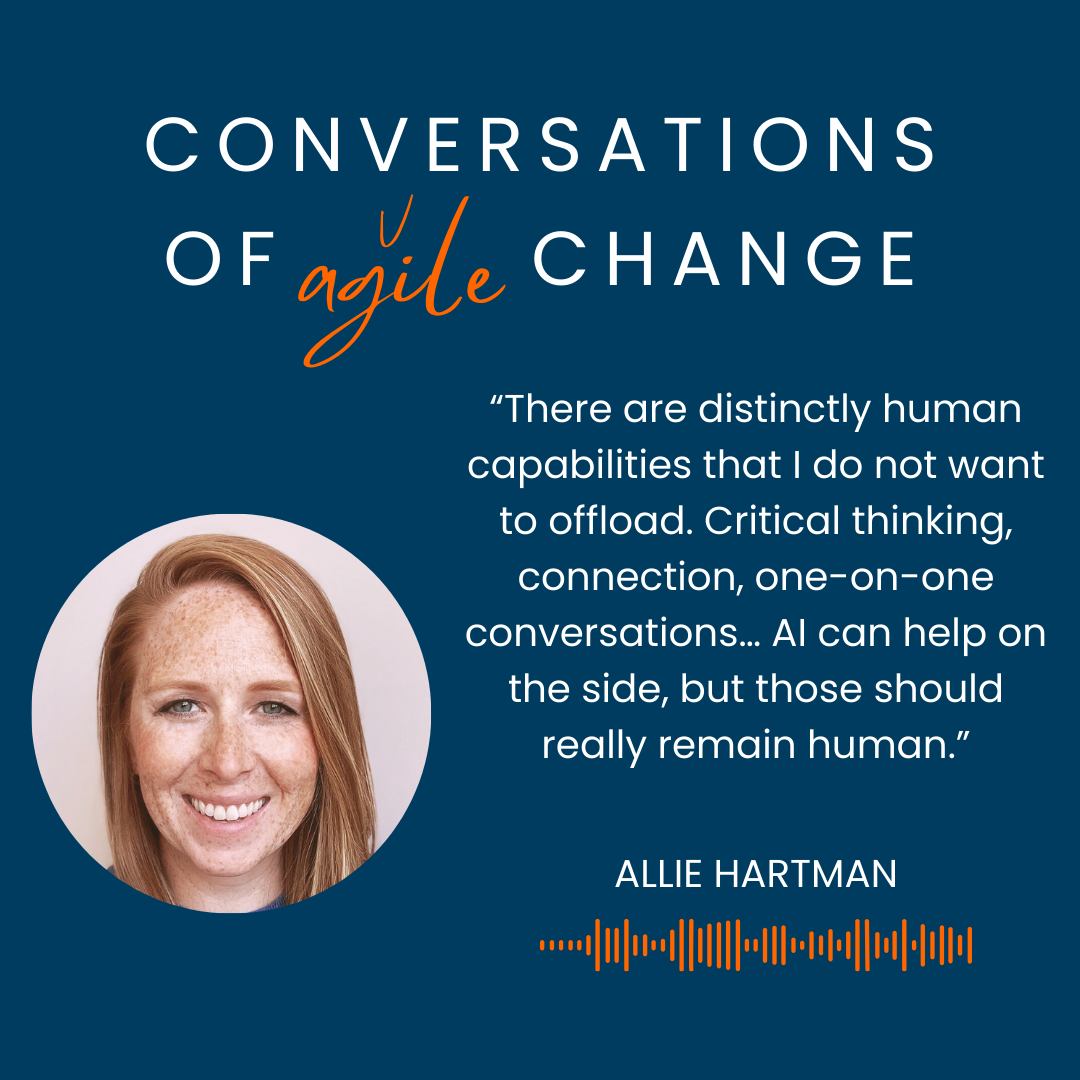
But there are distinctly human capabilities that I do not want to offload, that I don’t want to lose in my
own brain to just say, “Hey, AI, do this.” Now, AI can help, but there are always those critical thinking,
problem solving, innovative, innovation, one-on-one connections, all of that that are truly human that can
maybe use a little bit of AI help on the side, but they should really remain human
Dr. Jen Frahm:
See, that has me thinking because I’m sure you’ve seen the fear articles out there about continued use of
AI is reducing IQ, it’s reducing cognitive ability. We’re getting lazier, right?
And I don’t know how I feel about that because I think I’m okay with a little bit of lazy because my brain
is always on. And if that’s an opportunity to power down, then that’s great. But I also see what the fear
would be. How do you see that AI helps you stay with those strengths so you’re learning your curiosity,
your innovation? Is that a personal discipline?
Because I know that when I’m working with AI, it can feel really, really addictive and it can feel very,
“I’ll just let it do more and more and more because that’s easier for me.” And so it almost, maybe this is a
moral question, I don’t know, or an ethical question. But it’s an interesting one for me because I can see,
yes, to your point, I use AI every day, and I think I’m fairly transparent with it
What I haven’t been able to do was that situation you described before, I’ve actually given it everything
that I’ve ever written. So, that’s some close to half a million words over 20 years and tried to have it just
replicate me and say what I would say and do what I would do. And it doesn’t do that very well. The
memory capability is not strong enough to synthesize that.
So yeah, I’m sorry, Allie, I’m getting off track here. But I think for me, it’s this question around what is the
process for you using it for your strengths and not giving it everything to do? Does that make sense?
Allie Hartman:
Yeah, yes. And I think there are some scenarios where I’ve tested it that I’ve said, “Oh, it’d be really great
if it could just make this full PowerPoint for me.” And then I try to do it and I’m like, “This is junk.”
And I’ll spend some time going back and prompting it better and being like, “Nope, not this. Nope.
Remember I said this. Nope, this.” And it’s still not nearly as good as I could have just spent 20 minutes to
just dive in and do it. So, I think there’s totally that balance of seeing, okay, it’s really good at this, it’s not
so good at this. I really need to use my human skills.
And so I use it quite a bit in my idea generation and my brainstorming. And so, I often will have an idea,
whether it’s it comes up in conversation, someone mentions something, I read something on LinkedIn and
I get that kind of curiosity spark. And then I work with it as really I would a colleague.
Now I work from home, and so I’ve got virtual meetings a million times a day, but it acts as that person
that I can ask the dumb questions to and that I can go back and forth without bogging down someone else
that maybe doesn’t care so much about this topic. And so I’m able to go back and forth and say, “Okay,
what about, I’m thinking about this, I don’t know how this piece fits in, help me work it in based on what
you made about me.”
Because I similarly I have a lot of my writing in there as the knowledge base and it will work out pieces
and using those human skills where you say, “No, that is junk. Don’t write about that. Don’t include that.
No, I want to talk about this. No, I want to work through this.” And having that iterative back and forth to
really be a collaborator and thought partner to be able to work through the pieces.
And so I have a good relationship with my ChatGPT is my kind of go to, and I understand what it’s very
good at. And I can also quickly identify, even if I test out some new scenario or some new product or new
idea that I’m working on, I know what I’m trying to get out of it. I’m not just asking for, “Hey, solve world
hunger, but help me work through this scenario.”
And I have enough experience and background and knowledge about the topic that I can kind of quickly
determine, “No, that is junk. No, that is not accurate. That does not make sense. Show me your sources.”
And sometimes it will say, “Oh, we made that up.” And I say, “Yeah, don’t make up stuff.”
And so I think being able to test and experiment with whatever AI you’re using, or multiple. A lot of
times I’ll put the same type of prompt into multiple AI tools and see which one it’s better at. There are
some things that each tool is slightly better at, and where your knowledge and memory is located so it
understands your context a little bit better.
But being able to work with it and understand, you know what, it’s just faster if I do this myself, which is
going to be the case for some things and it’s just not good enough yet. So, I think just really testing and
experimenting and being able to see what works and what doesn’t and where your comfort level is too of,
“Oh, I’m getting…”
There’ll be some times where I’m like, “You know what? I’m being a little sitting in the backseat because
I’m offloading a little bit too much. Let me get back in there and let me write out my own ideas. Let me
post my own whatevers, my own working through it first before I throw it into an AI tool.” Sometimes
you need it if you’re staring at the blank screen and you say, “I just can’t even get started.”
It’s good at ideating, but a lot of times it’s better if you have something that you know or the direction or
scope or what you’re kind of looking at to then have something to react to say, “Okay, no, I know it’s not
this. It’s something closer to this. Nope, go more in this direction,” and kind of working with it and
iterating.
Dr. Jen Frahm:
Awesome. So the latest is, as I’m hearing again at the conferences and the showcasing, is the use of
agentic AI. What’s your prediction for 2026 in terms of change practitioners competence with agentic AI?
Allie Hartman:
I’d say across the board, we’re still not there yet. I feel like it’s a little bit the new buzzword, but on top of
AI, the new hype. And I haven’t seen a ton of great examples when it’s done super well. If it’s an agent, a
custom GPT, an assistant, a Gem, each tools get their own thing and it’s for your personal use.
It has your context, it has your instructions, it has your idea, and you’re just trying to use it more
repetitively that you can work with it and you understand what the point is. I’d say that’s great, especially
for tasks where it’s like, “Hey, here’s my communication agent. This really helps me write my
communications. Hey, here’s my ideating on new products agent. Here’s my training plan and enablement
agent. Here’s one that helps me with metrics.”
If we get to a world where some of those things can connect, I think that would be great just for
connecting the dots and making sense together, we could get there. But right now, it’s a little bit more
piecemeal, I feel like, to understand and have it be good enough to be fully automated and say, “Just go.”
I don’t think we’re there at all yet. You really need that human to do the check in the same way that you
would not just give some big project to an intern with little instruction and say, “Go do it, now send it to the CEO without checking.” You would want to check along the way, provide feedback, iterate with
them, coach them on things.
And that’s the same with each AI iteration and agent where you’d have to go back and forth and say, “No,
remember these are the instructions. No, remember we wrote that thing three weeks ago, make sure you’re
referencing that, remember this timeline,” and go back and forth a little bit.
Dr. Jen Frahm:
Yeah, awesome. So next year, 2026, you’re coming to us with one of our webinars. You’re bringing the
Change Curiosity Lab to us to showcase how you are using AI with agile change practices. As a result of
that webinar, what do you hope that the change profession understands differently, perhaps by this time
next year? So, let’s forward-cast it. What do you think’s going to change for the change profession?
Allie Hartman:
I think, I’m hoping, that we will start to disarm some of that fear that AI is just going to take my job. I’m
hoping that by this time next year, we can get to fewer people feeling that way and more people feeling a
bit more empowered to use the tools at their disposal on top of their human superpowers. And it’s similar
to probably when the Microsoft Suite came out or all of these other online tools or even your softwares
and things, there was that fear.
Similar to probably when you’re doing book reports, you had to go to the library and use the card catalog,
and then the internet came out, and then Google came out, and then now we’re using AI. And so it’s just
that it’s a mindset shift, it’s a big behavior change, and it takes time to experiment and to grow that skill.
And even just that memory, I always say when I first started, I had to put a physical sticky note in front of
my computer right in front of my face that said, “Can AI help me do this?” Because I was such an
executor that I had to totally change the way I was thinking because I would always just jump in and start
doing the thing.
And then my boss would say, “Did you try AI?” And I’d say, “Shoot, forgot to do that.” It’s that big
mindset shift for you to say, “Wait, I have a partner now. I can have someone help me do this.” And so
once that I got into that rhythm, the sticky note came down.
Then once agents and assistants started happening, “Hey, am I repeating the same prompts over and over
the same instructions? Can an assistant help me do that?” That was a new change.
And so I think sometimes it takes some of that just physical reminder that says, “Hey, just stop for a
second. I know you’re super busy. I know you’ve got back-to-back meetings, but can AI help me do one
little piece of this? Can it help me draft that thing? Can it help me edit that thing? Can it help me come up
with the outline, send the email, help me make sense and prioritize my calendar?”
All of those little things, can it help me take better notes and send out the meeting notes after the fact? All
of those little pieces are just building that behavior change step by step. And so I think having some of
that experimentation mindset and being able to work out loud is a great one to do with your teams to help
build that capability to say, “Okay, I have a partner now that can help me do some of this so that I can
now focus on the human work,” which is so important in our Career.
Dr. Jen Frahm:
Okay. So this question’s going to be a little bit like a personality quiz in that if you could… This will tell
us a lot about you, Allie. If you could eliminate one boring task of change management through the use of
AI, what would it be?
Allie Hartman:
That could be challenging. For me, it would be the follow-up email. It’s just a lot. Taking the notes, which
I do love to physically take the notes, either writing it down or typing it out, that commits it to my
memory, but having the fail-safe of being able to transcribe or record and then have the notes come in
automatically. And then again, check them over with a human to say, “Oh, this is incorrect or this is
right.”
And then be able to click a button and say, “Now make this a client approved email summary so that I can
really highlight action items and send this off really quickly.” That’s one for me that I love to automate.
Some of them, let’s see, I mean, a lot of them, a lot of ideas you could do right now. Come up with
questions from my stakeholder, outline this training, come up with…
You know the one that I don’t like to do actually? Coming up with engagement activities within a
training, whether it’s a poll question or an activity, I’m leading an Ask Me Anything session at work and
I’ve been making them themes. So one was Halloween themed, one was Thanksgiving and the US
themed, and I had it just come up with really goofy clearing the table with AI or past the pumpkin
microphone or just really silly things that is just not my go to.
And so that one is a really easy one to say, “Here’s what I’m talking about. Here’s the actual content I’m
trying to talk about. Now add in silly Thanksgiving themed things or Halloween themed things.” And
then it pulls that in really quickly because that is not my strong suit for me personally
But there are a lot of tasks, honestly, I did an exercise one time to go through typical change activities and
AI can really help do a lot of them. There were few that were no AI at all. And it’s those conversations,
it’s the having the focus groups, it’s connecting with the people.
And again, you can come up with the questions, but there were a lot of tasks that it’s like, “Hey, you know
what? AI can do a lot of this first lift, at least the first draft of it, or help me really question what
perspectives am I not looking at or what am I not thinking about?” But there is quite a lot that AI can
already do with some context about what’s going on.
Dr. Jen Frahm:
Yeah. I think for me, it’s the spreadsheet, the change impact spreadsheet. I’m like, “Let’s just-“
Allie Hartman:
That’s another good one.
Dr. Jen Frahm:
“… knock that on the head.” And look, in full transparency, you mentioned before the importance of being
transparent about the use of AI. How we’ve used AI in this podcast is I’ve fed my ChatGPT instance
examples of Allie’s writings, the brief on what we’re doing on the webinar and said, “I want a set of
questions that are going to enhance.”
I then sent that to Allie and said, “Well, look, here’s way too many questions for you, but tell me which
ones really resonate with you.” Allie has done that, sent it back to me, and then I’ve mangled pretty much
everyone that she said she wanted to hear. So, this is the joy of AI in the human process, the human plus
AI, right, Allie?
Allie Hartman:
Exactly.
Dr. Jen Frahm:
We are coming to a close and you’ve been really, really generous as per usual with everything that you’ve
shared, obviously, we want everybody who’s listening at the moment to attend the webinar, and I’ll put the
links in the show notes. But how can the listeners give back to you? What’s your ask of the listeners?
Allie Hartman:
Sure. I would just say for one, be curious. That is always going to come back for me. That’s always one of
those skills and behaviors that I kept being drawn to is just being curious. Ask the question, what if, how
might we, what other things am I not thinking about, how else could we go about this? And especially in
the AI world, how do we totally reimagine our role?
There are going to be pieces that get offloaded to AI and that AI automates or augments and takes over.
So how do we create that future for our profession in what it looks like in the future? Maybe we
completely shift things around and we do things in a different way. And so, I always see curiosity asking
those questions.
And of course, AI can help you come up with good questions to really think about and question your own,
“This is how we’ve always done it, or that won’t work here,” kind of awareness. And so I would just ask
everyone to add in one curious question at the end of every meeting or within the meeting.
And it can start really simply with just one small question, whether it’s a team meeting or a status update
or a meeting with a sponsor. If you just ask that one question, “Hey, what’s your thinking behind this
decision?” Or, “Hey, how can I help this scenario even more? How can my team support you better so
that this change is less hard for you?”
Any of those little one questions just thrown into a conversation can help really drive that psychologically
safe environment and one that’s more curious that can ask more questions and feel safer to learn and grow
together. So, that would be my one ask for me personally.
If you would like to, you can find me on LinkedIn. My company, the Change Curiosity Lab, is also on
LinkedIn. I post quite frequently there on both accounts. I’ve got a bunch of Substack blogs that I post
regularly and goes out to my subscribers, got a website with tons of information. So, there’s lots of ways
to find me, but LinkedIn’s probably the easiest one.
Dr. Jen Frahm:
Beautiful. Allie, you are the epitome of work out loud, which is one of our most favorite agile change
practices. So, thank you so much for joining us on a Conversation of Agile Change.
Allie Hartman:
Thank you for having me.