
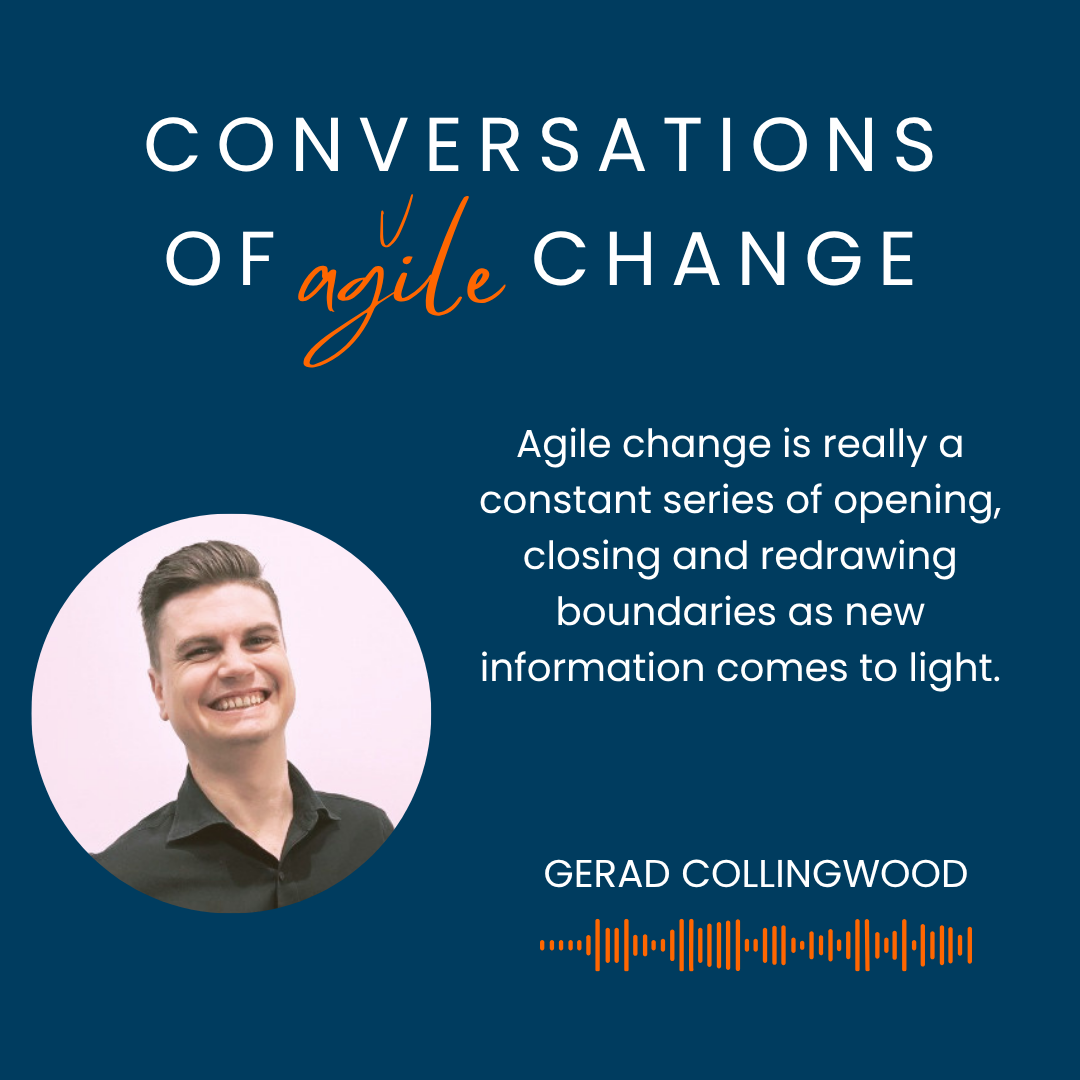
Recently on the Conversations of Agile Change podcast, I sat down with change practitioner and ACLI alumnus Gerad Collingwood for a conversation that genuinely shifted my thinking.
As someone who spends most of her waking hours immersed in change management, leadership and communication, it is increasingly rare that I come across a concept that makes me stop and rethink what I thought I knew.
This was one of those moments.
Gerad introduced me to the idea of boundary work.
Not personal boundaries. Not governance boundaries. Not organisational charts.
Boundary work.
And the more we talked, the more I realised that change practitioners spend much of their time doing exactly that, even if we don’t have a name for it.
The signs of a stuck organisation
Gerad’s starting point was deceptively simple.
How do you know an organisation is stuck?
His answer wasn’t project delays, poor engagement scores or missed milestones.
Instead, he pointed to symptoms many of us see every day:
- The same conversations happening over and over again
- Decisions being revisited repeatedly
- Issues that were supposedly resolved resurfacing months later
- Projects that have approval but never seem to start
- Teams circling problems without making progress
When you look closely, these situations often have something in common.
The organisation is operating within boundaries that no longer serve what it is trying to achieve.
What exactly is a boundary?
At first, I assumed boundaries were primarily about control.
Rules.
Governance.
Authority.
Structure.
But Gerad challenged that assumption.
He described boundaries as the lines that shape how we understand and navigate the world. They determine what is inside and outside, what belongs and what doesn’t, what is possible and what isn’t.
Some boundaries are visible:
- Departments
- Teams
- Reporting lines
- Budgets
- Processes
Others are invisible:
- Assumptions
- Beliefs
- Traditions
- Unwritten rules
- Shared expectations
In organisations, those invisible boundaries can be far more powerful than the formal ones.
One of the examples that struck me was his observation that assumptions are simply boundaries we’ve created around what we believe to be true.
And if you’ve worked in change for any length of time, you’ll know how many initiatives are constrained by assumptions nobody has questioned.
“We’ve always done it this way.”
“That team would never agree.”
“The system can’t do that.”
“The regulator won’t allow it.”
Sometimes these assumptions are correct.
Often they are not.
Boundaries create safety
The conversation became particularly interesting when we explored the relationship between boundaries and creativity.
Many people assume creativity flourishes when there are no constraints.
In reality, the opposite is often true.
The right boundaries create psychological safety.
When people know:
- What problem they are solving
- Who is involved
- What success looks like
- How much time they have
- What authority they possess
They become more willing to experiment.
They can focus their energy.
They can explore possibilities.
In other words, good boundaries create the conditions for innovation.
Poor boundaries create confusion.
No boundaries create chaos.
Why this matters for Agile Change
The real lightbulb moment for me came when we started discussing Agile.
Gerad described Agile change as:
“A constant series of opening, closing and redrawing boundaries as new information comes to light.”
That statement stopped me in my tracks.
Because that’s exactly what experienced change practitioners do.
Every day.
We continually adjust:
- Scope boundaries
- Stakeholder boundaries
- Team boundaries
- Decision boundaries
- Communication boundaries
- Governance boundaries
We gather feedback.
We learn.
We adapt.
We redraw.
Seen through this lens, Agile isn’t the absence of structure.
It’s the continual refinement of structure.
Perhaps one of the reasons Agile often appears messy from the outside is because people only see the movement of the boundaries, not the intentionality behind them.
Boundary work as a dynamic change capability
The more I reflected on our discussion, the more I’m convinced that boundary work may be one of the most important capabilities for modern change practitioners.
Think about what we actually do.
We help define problems.
We decide who needs to be involved.
We shape conversations.
We determine what information moves where.
We help leaders understand what is in scope and out of scope.
We create spaces where people can make sense of uncertainty.
Every one of these activities is boundary work.
And unlike traditional project environments where boundaries might remain relatively stable, today’s environments require them to be continually adjusted.
Boundary work is dynamic.
It requires judgement.
It requires curiosity.
It requires the ability to hold structure and flexibility simultaneously.
AI and the new boundary challenge
Towards the end of the conversation, we explored the relationship between AI and boundaries.
It turns out prompting AI is an excellent lesson in boundary setting.
Give an AI tool vague instructions and you will often receive vague results.
Provide clear constraints, context and intent, and the quality improves dramatically.
In many ways, AI is exposing something that was already true.
Humans often struggle to define boundaries clearly.
We leave too much unsaid.
We assume shared understanding.
We forget that clarity is a prerequisite for effective action.
As AI becomes increasingly embedded in organisations, I suspect questions of boundary setting, ethical boundaries, information boundaries and authority boundaries will become even more important.
A final reflection
One of the reasons I enjoy hosting the podcast is that occasionally a guest introduces an idea that reorganises existing knowledge rather than simply adding something new.
Boundary work feels like one of those ideas.
It provides a lens for understanding why organisations get stuck.
It explains why some teams thrive under constraints while others struggle.
It offers a fresh perspective on Agile, leadership, communication and power.
Most importantly, it reminds us that effective change isn’t simply about moving people from A to B.
Sometimes it’s about redrawing the boundaries that define A in the first place.
And that might be some of the most important work we do.