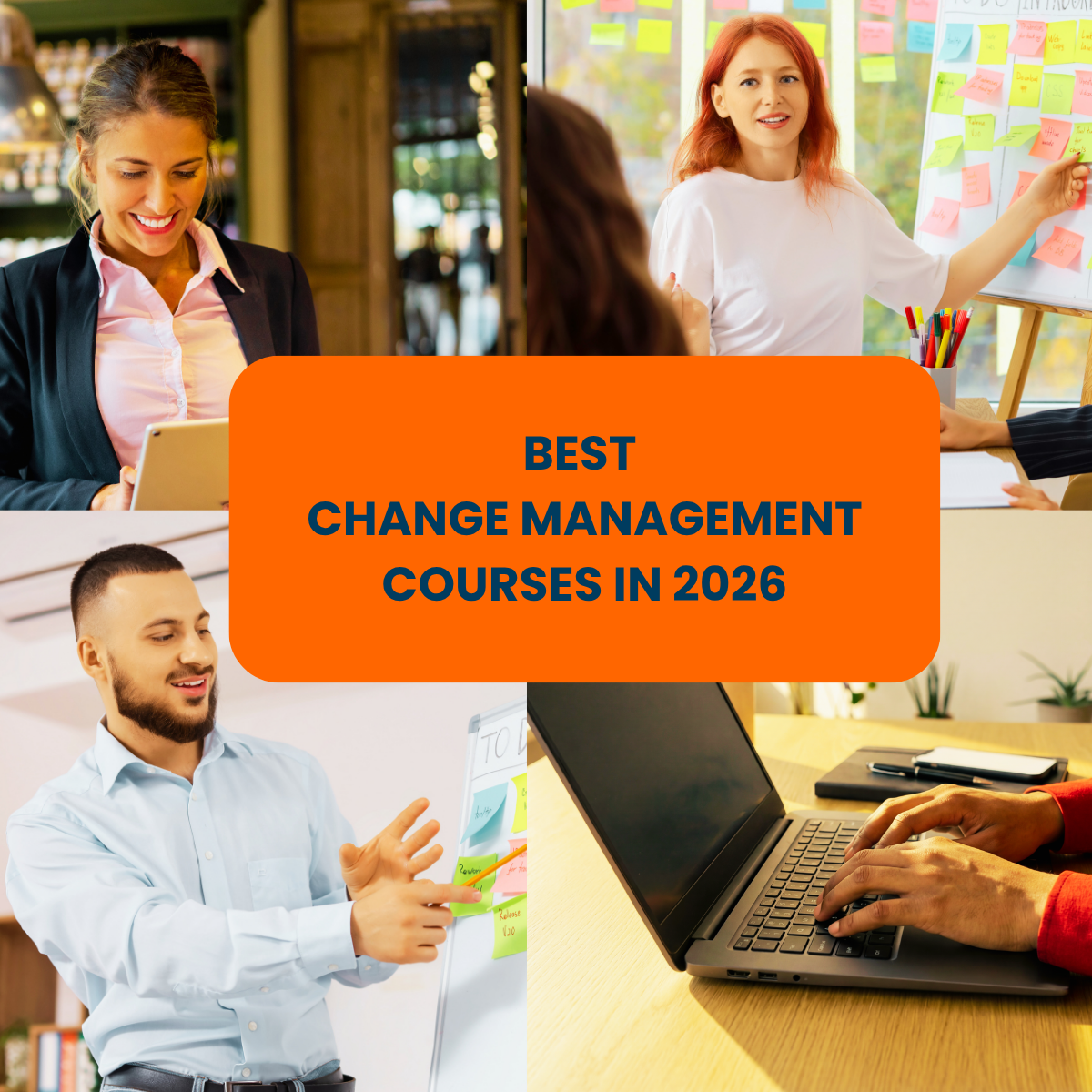
The Best Change Management Course in 2026: What to Look for (and What Actually Delivers)
If you’re searching for the best change management course in 2026, you’re not alone.
With constant disruption, AI-driven transformation, and increasing pressure on leaders to deliver results faster, the demand for practical, modern change management training has never been higher.
But here’s the problem:
Most courses still teach yesterday’s models for today’s challenges.
So how do you choose a course that actually prepares you for the reality of change in 2026?
Let’s break it down.
What Defines the Best Change Management Course in 2026?
Before we talk about specific courses, it’s worth getting clear on what “best” actually means in today’s environment.
The best change management courses now:
- Go beyond theory and focus on real-world application
- Reflect agile, iterative ways of working
- Build practical capability, not just knowledge
- Integrate data, communication, and engagement strategies
- Acknowledge the human side of change (not just process)
And increasingly, they draw on disciplines like behavioural science and neuroscience to help change actually land.
Why Agile Change Management Is Leading the Way
Traditional change management approaches were designed for stable environments.
2026 is anything but stable.
Agile change management has emerged as a more effective approach because it:
- Embraces uncertainty and iteration
- Focuses on continuous engagement, not one-off comms plans
- Uses data-informed decision making instead of assumptions
- Prioritises visibility and transparency
In short, it reflects how change actually happens now. It’s a way of describing a truly modern way of doing change. And you don’t even need to be working in Agile to gain the benefits!
The Agile Change Manager Certificate (ACM)
One course that consistently stands out in this space is the Agile Change Manager Certificate.
Designed for time-poor professionals, it focuses on building capability you can showcase immediately rather than just academic understanding.
What makes it different?
1. Practical, immediately usable tools
The course includes over 50 templates and practical frameworks you can apply straight away.
2. Micro-learning format
Short, focused lessons make it easy to fit learning into a busy schedule—without sacrificing depth.
3. Built for modern change environments
It covers:
- Data-informed decision making
- Continuous engagement practices
- Visual and transparent communication
- Working in uncertainty
4. Designed for real-world application
Assessment is based on experiments and application, not just theory.
Beyond Certification: Building a Future-Ready Skillset
Here’s the thing most people miss when choosing a course:
A single course might build capability—but it rarely builds confidence across multiple dimensions of change.
That’s where integrated learning pathways come in.
Why “Neuroscience Meets Change Management” Matters
One of the biggest shifts in recent years is the integration of neuroscience into change practice.
Courses like Brain-Friendly Change explore how people actually experience change at a cognitive and emotional level.
This is where neuroscience meets change management.
It helps you understand:
- Why resistance happens
- How to reduce overwhelm
- How to design change that feels easier to adopt
- How to work with (not against) how the brain processes uncertainty
This isn’t just “nice to have”—it’s increasingly essential for effective change leadership.
Design Thinking Meets Change Management
Another powerful addition to modern change capability is design thinking.
It shifts the focus from:
“How do we implement this change?”
to
“How do people experience this change?”
Design thinking brings:
- Empathy-led approaches
- Rapid prototyping
- Co-creation with stakeholders
- Better alignment with user needs
When combined with agile change and neuroscience, it creates a much more holistic approach.
The Best Value Option: The Future of Change Package
If you’re serious about building capability—and not just ticking a certification box—the best value for money is often a bundled approach.
The Future of Change Package combines:
- Agile Change Manager Certificate
- Brain-Friendly Change (where neuroscience meets change management)
- Design Thinking meets Change Management
This combination gives you:
- Practical tools
- Human-centred insights
- Modern delivery approaches
In other words, it prepares you for the full complexity of change in 2026 – AND you get 25% off the normal pricing!
Flexible Options: Payment Plans and Discounts
Speaking of pricing, we know that budgets are tight right now—for individuals and organisations.
To make learning more accessible:
- Payment plans are available on request
- Discounts are offered for association members (e.g. ACMP, Change Management Institute, MNCMN)
This makes it easier to invest in capability without needing a large upfront commitment.
Final Thoughts: Choosing the Right Course for You
The best change management course in 2026 isn’t the one with the longest history or the most theory.
It’s the one that helps you:
- Deliver change in real conditions
- Engage people effectively
- Navigate uncertainty with confidence
- Apply what you learn immediately
For many professionals, the Agile Change Manager Certificate is the strongest starting point.
But for those looking to future-proof their skills, the Future of Change Package offers a more complete, practical, and high-value pathway.
Ready to Build Your Change Capability?
Explore the Agile Change Manager Certificate or step into the Future of Change Package to develop the skills you’ll actually use.
Because in 2026, change isn’t slowing down.
And neither should your capability.