

AI isn’t coming for your job — at least not yet. But it is coming for how you think
about your job.
Across every industry, artificial intelligence is reshaping how we work, learn, and
make decisions. While many professionals rush to master new tools, the real
differentiator isn’t technical fluency — it’s mental agility.
That’s where an agile mindset gives you the edge.
What is an agile mindset?
At its core, an agile mindset is about embracing uncertainty and adapting fast. It’s a
way of thinking that sees change as an opportunity, not a threat. It helps us stay
calm and curious amid complexity — exactly what’s needed in today’s digital
transformation landscape.
Unlike traditional approaches that rely on rigid plans and hierarchical control, an
agile mindset thrives on learning, feedback, and experimentation. It recognises that
progress often comes from “failing forward”: trying, learning, adjusting, improving.
Key shifts include:
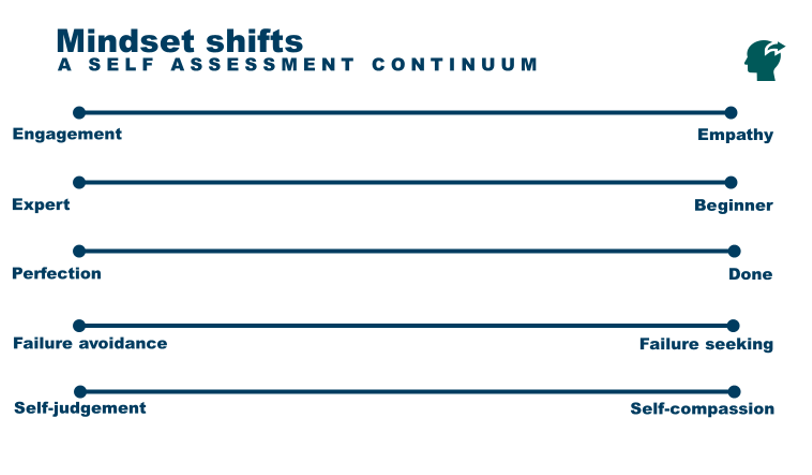
1️⃣ Expert → Beginner Mindset
In an age where AI tools evolve weekly, clinging to “expert status” can hold you back. A beginner mindset lets you stay open to new ways of working, learning alongside the technology rather than trying to control it.
Example: Instead of waiting for formal AI training, a leader with a beginner mindset experiments — prompts ChatGPT to summarise meeting notes, tests new analytics dashboards, and shares the learning with their team. Curiosity replaces fear.
2️⃣ Failure Avoidance → Failure-Seeking
AI innovation thrives on iteration. The faster we test and learn, the faster we discover what works. “Failing fast” isn’t about mistakes — it’s about feedback.
Example: A project team experimenting with AI-driven insights tests multiple models quickly, learns which ones produce bias, and adjusts before rollout. Every “failure” improves accuracy, transparency, and ethical decision-making.
3️⃣ Perfection → Progress
AI tools evolve too quickly for perfect plans. Leaders who focus on progress over perfection move faster — releasing early versions, gathering feedback, and adapting as they go.
Example: A communications team uses generative AI to draft copy, reviews and refines it, then measures engagement. The lesson? Done and improved beats perfect and late.
4️⃣ Self-Judgment → Self-Compassion
Many people feel imposter syndrome in the face of AI. A self-compassionate mindset replaces “I should already know this” with “I’m learning, and that’s progress.”
Example: A manager admits they’re learning how to use AI to streamline workflows and encourages their team to do the same. This vulnerability builds trust and models adaptive learning.
5️⃣ Engagement → Empathy
AI can process data, but it can’t replace empathy. As automation grows, human connection becomes the differentiator. Agile leaders lead with empathy — understanding fear, supporting experimentation, and creating psychological safety.
Example: When introducing AI to automate reports, a leader listens to employee concerns about job security, communicates openly about benefits, and co-designs new roles around higher-value work.
These shifts turn disruption into discovery — and fear into fluency.
Leading through digital and AI transformation
Leaders navigating AI transformation face a unique challenge: balancing speed,
ethics, accuracy, and empathy.
From our Change Leader: The Basics course, the Leading Digital and AI
Transformation lesson highlights a few powerful ways to lead well in this space:
1️⃣ Role model “test and learn”
Lead by example. Share small experiments openly using the language of curiosity:
“Today I learned…”
“I was surprised to see that…”
“Have you tried…?”
Visible learning builds psychological safety and normalises exploration.
2️⃣Shift focus from fear to fluency
In digital transformation, people often operate across three zones: control, concern,
and influence. Leaders help teams move from what they can’t control (AI replacing jobs) to what they can influence (learning, adapting, collaborating).
3️⃣ Anchor everything to purpose
AI brings speed and accuracy — but without a strong anchor in purpose, ethics, and
empathy, those gains can come at a cost.
Ask:
- Which decisions should remain human?
- Which can be algorithmic — and why?
- How do we audit both against our purpose?
Leading through AI isn’t about becoming an expert in algorithms. It’s about making
better human decisions in a digital world.
The real advantage: human adaptability
AI evolves exponentially. What matters now is how quickly we can evolve alongside
it. The agile mindset strengthens your ability to:
- Stay curious instead of overwhelmed.
- Experiment safely, test small, and scale smart.
- Keep learning as technology shifts.
- Combine human creativity with machine intelligence.
In short: agility is your best strategy for AI relevance.
Future-fit leadership starts with mindset
You don’t need to outsmart AI — you need to outlearn it.
Building an agile mindset gives you the resilience, curiosity, and courage to lead
confidently through digital transformation.
Start today with our Agile Mindset Micro-Credential and explore the “Leading Digital & AI Transformation” lesson in Change Leader: The Basics to see how agile thinking transforms leadership in the AI era.