
AI adoption isn’t a training problem
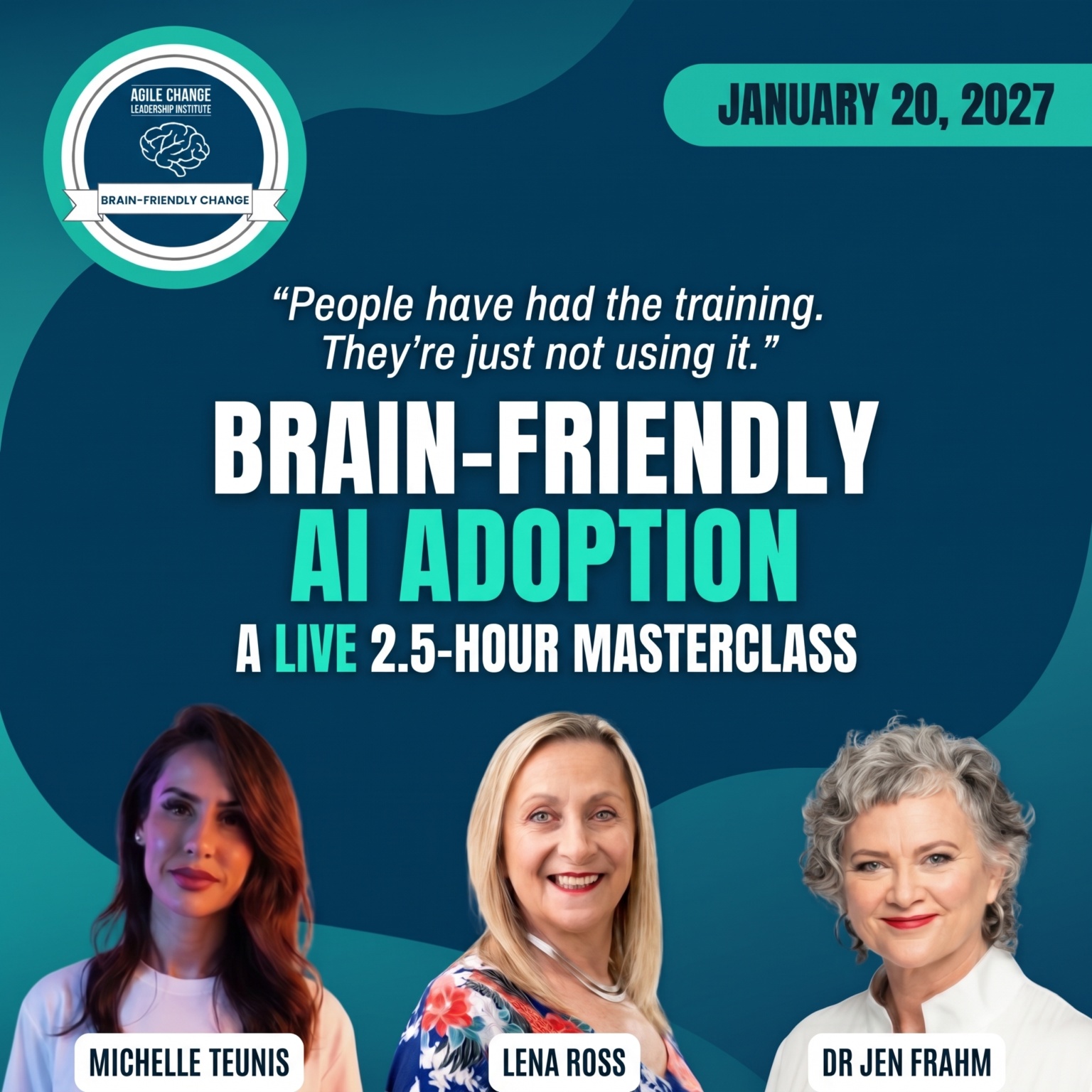
A new live masterclass from the Agile Change Leadership Institute brings the Brain-Friendly Change toolkit to the change most practitioners are being handed right now.
The story is familiar by now. The organisation rolls out an AI tool. Licences are bought and training sessions run, and the attendance numbers look good. Six weeks later, usage is a fraction of what the business case promised, and the explanation going around the leadership team is “resistance”.
The usual next move is more training, and it rarely works, because the problem was never a gap in skills. AI adoption stalls for brain reasons, not tool reasons.
The brain isn’t change-averse
The brain is pro-survival, pro-efficiency and pro-belonging. It resists change only when that change looks like a threat to one of those three, and an AI rollout manages to threaten all three at once.
Survival: minimise threat, maximise reward. The brain scans for threat before it looks for reward. When AI arrives with a productivity target attached, the first question isn’t “how will this help me?” It’s “is this how they cut headcount?” Until that question is answered, the benefits barely register.
Efficiency: the energy conservationist. The brain is expensive to run and it knows it, so it weighs every change on effort against reward. With AI, the effort lands today: learning the tool, checking its work, second-guessing its answers. The reward is months away in a business case nobody has read. On that maths, the old way wins.
Belonging: the social connector. People take their cue from the people around them long before they take it from a comms plan. If the team isn’t visibly using the tool, and the leaders who announced it aren’t either, the individual hesitates too.
And the prediction machine runs all three. The brain doesn’t wait to see how a change turns out. It predicts the ending from every change that came before. In an organisation that has been through two restructures and a systems replacement that ran over, people have already decided how this one ends.
Training people on the tool touches none of this, but change design can address all of it.
Brain-Friendly AI Adoption: a live masterclass
The masterclass grew out of the Brain-Friendly Change course, and out of what learners have asked for over two years of feedback. The request that came up most widely was for more real-world worked examples: seeing the tools used on an actual change, not just explained.
So that’s what the session does. Over two hours, the creators of Brain-Friendly Change take one AI rollout from first announcement to embedded habit, working through the toolkit at each stage. The session runs in four sprints, following the four phases of the Brain-Friendly Transformation Map: Discover, Design, Deliver and Adopt.
It’s a working session, not a theory refresher. For each example, attendees see the tool used, the finished artefact, and how it was built. Questions are collected throughout and answered in two dedicated Q&A windows. Attendees leave with the completed artefacts (canvases, diagnostics and worksheets) to adapt for their own AI rollouts.
There’s also a deliberate break, which seems fitting in a session about cognitive load.
Who’s presenting
The masterclass is presented live by the three people behind the course.
Dr Jen Frahm is co-founder and Managing Director of the Agile Change Leadership Institute. She is an organisational change expert, speaker and the author of four books, including The Agile Change Playbook and Change. Communication.
Lena Ross is co-founder and Director of the Agile Change Leadership Institute and co-author of The Agile Change Playbook and a certified Neuroscience and Neurodiversity Coach.
Lena’s work draws on the latest thinking in change management from areas such as design thinking, future of work, digital, hardwired human behaviour and agile mindset and approaches. Her experience is complemented by her Master of Business Administration (MBA) qualification, and she applies sound academic and business discipline to the development of practical and innovative solutions. Lena’s first book Hacking for Agile Change was released in July 2017, followed by Change Management The Essentials published in February 2020.
Michelle Teunis is co-creator of the Brain-Friendly Change course. As an experienced change, agile practitioner and specialist in applied organisational neuroscience, Michelle has led and delivered change and capability for 25 years, partnering with some of the most iconic brands in digital, banking, media, airlines, education and resources. She’s worked in multiple change and transformations including world firsts in AI, and most recently led global change in psychosocial risk, for Australia’s largest company.
Who it’s for
The session suits change practitioners, transformation leads and people leaders who are responsible for making AI adoption actually happen. You don’t need to have done Brain-Friendly Change first, though alumni will recognise the tools.
Date: January 20, 2027, 8.00 am – 10.30 am
Format: Live online, two and a half hours [replay included for everyone who registers]
If your organisation is somewhere between “we’ve done the training” and “why isn’t anyone using it”, this session is built for you. Register on Eventbrite