Capabilities, not process: our take on the three agile change capabilities
Every so often we get asked a very reasonable-sounding question:
“Can you give us a framework or process for delivering agile change?”
Eeeek! No!
And there’s a good reason for that answer — one that goes right back to how this thinking began. When we built the Agile Change Playbook in 2020, we made a deliberate choice not to hand people yet another framework. Change practitioners are already inundated with frameworks and processes.
As they move from organisation to organisation, they adapt to the ‘framework of the day’ already in place. The nature of the work is fraught with continuous change and ambiguity — which means we need to adapt quickly and think differently. The once-predictable, prescribed ways of planning and delivering change simply don’t hold up in an environment of ongoing disruption.
So we asked ourselves a simple question: if we’re letting go of the approaches that served us well for so long, what are we actually shifting to?
The shift is towards principles, away from process
The organisations that have embraced agile most successfully talk about the power of principles first. Working with principles, rather than a prescribed formula, speeds up delivery and creates flexibility. We took the same logic and applied it to change — moving towards capabilities and away from process.
In an increasingly complex and ambiguous world, change practitioners need to draw on a range of tools and techniques so their efforts are genuinely fit for purpose. There’s an added benefit, too: a capability-led approach promotes sense-making and co-creation rather than compliance. So instead of creating yet another framework for agile change delivery, in the Agile Change Playbook we introduced a focus on capabilities.
The three core agile change capabilities
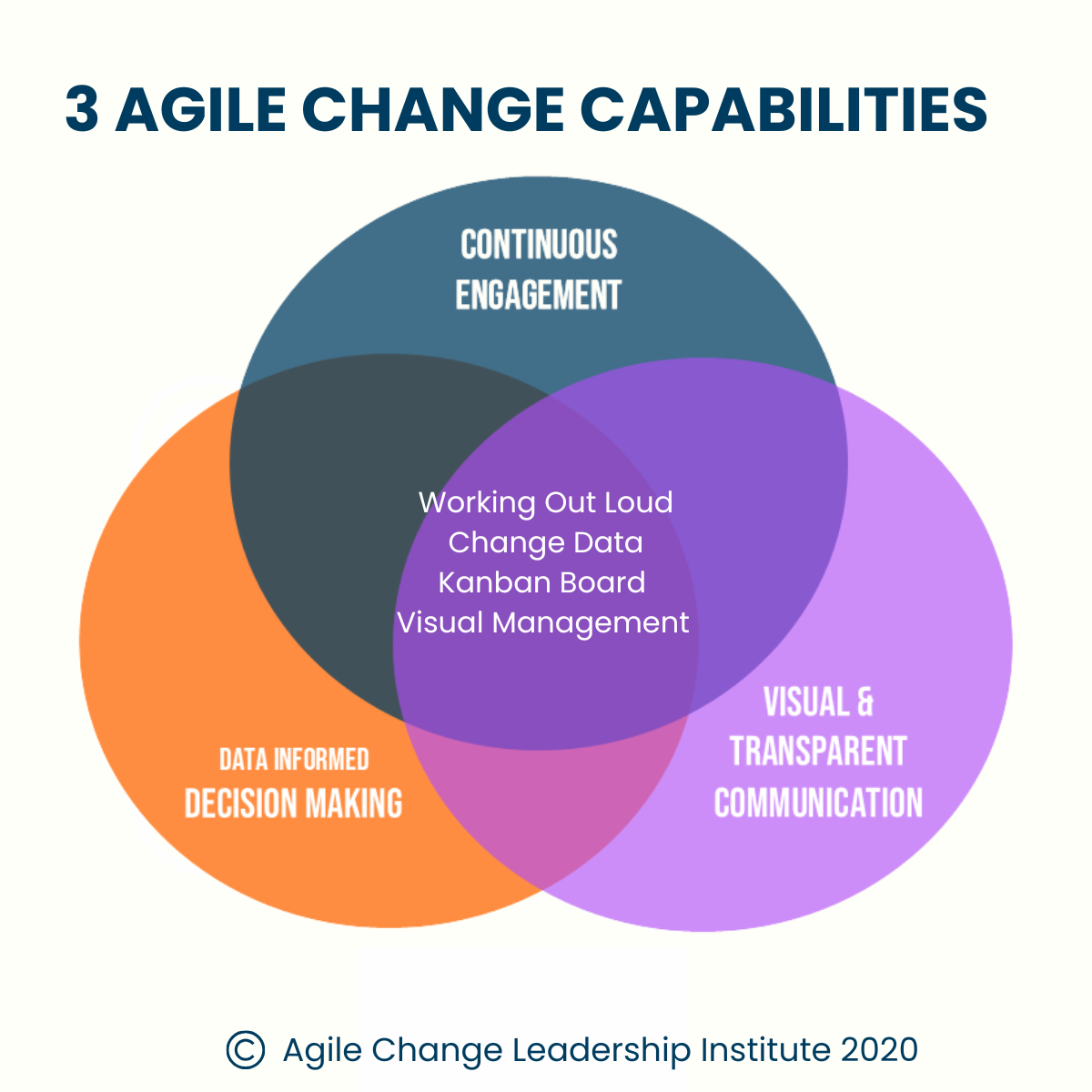
At the heart of agile change, we identified three core capabilities: data-informed decision-making, continuous engagement, and visual and transparent communication.
The real value shows up in the capabilities themselves — and, importantly, in the areas where they overlap. At the centre sit four core agile change practices we return to again and again: working out loud, change data, visual management, and Kanban boards. For each capability, and each overlap, we showcase agile change practices that practitioners can deploy depending on the initiative in front of them.
This shifts the central question away from “which methodology or process should I follow?” to something far more useful: “What needs to be done in this change initiative to meet the objectives and deliver the most value?”
And because it’s built on capabilities rather than a fixed sequence, you can plug and play these tools into any change model or framework you already use.
A leap of faith — that soon feels liberating
We know that for many practitioners, this is a leap of faith. It’s a move away from following a methodology that prescribes a checklist of artefacts to produce, towards initiating change activity that’s right-sized for the specific change in front of you — while staying open to iteration as you progress.
That shift soon becomes quite liberating. Working with guiding principles and capabilities keeps the mind nimble and open to possibility as we navigate environments of deep uncertainty. You stop asking permission of a template and start responding to what the change actually needs.
These aren’t just “agile project” capabilities
Here’s the misconception we most want to clear up. We tend to associate agile with tech-driven projects and fast-paced environments, and to assume that capabilities like data-informed decision-making, visual and transparent communication and continuous engagement only earn their keep inthose settings. Not so. These capabilities make you a more effective change manager whether you’re
on an agile initiative or a program governed by traditional waterfall. Let’s take each in turn.
Data-informed decision-making: a universal tool. Whether you’re on a waterfall project with fixed stages or an agile initiative that evolves iteratively, data helps you make better decisions about where to allocate resources, which stakeholder groups need more engagement, and how ready the organisation actually is. In waterfall projects, where decisions are often made well in advance, datagives you the foresight to predict roadblocks and points of resistance. Information on previous
change initiatives, current organisational capacity, or team sentiment lets you plan proactive interventions — so change lands successfully.
Visual and transparent communication: bridging the gaps in any methodology. Waterfall projects are often criticised for a reliance on long-term planning and documentation that creates a disconnect between planning and execution. Visual tools — dashboards, roadmaps, change impact maps — make the whole process clearer, bridging the gap between phases so everyone knows what’s happening now and what’s coming next. That transparency builds trust, reduces confusion
and increases buy-in, from leadership to end users. It also lets people see progress in real time, which sharpens decision-making even inside a rigid framework.
Continuous engagement: it’s always about people. Continuous engagement is often seen as an agile-specific principle because of the iterative nature of agile work. But engagement withstakeholders, teams and leadership is critical in waterfall too. The difference is that it needs to be consistent across the whole lifecycle, not just at the start and the end. Waterfall efforts can fall into the trap of engaging only at major milestones; sustained engagement — regular check-ins, feedback
loops, real conversations — keeps people invested and aligned, no matter the pace.
Agile capabilities are change capabilities
Ultimately, data-informed decision-making, visual and transparent communication and continuous engagement aren’t agile-specific at all. They’re fundamental to effective change management across the board. Whether you’re in a waterfall environment, a hybrid model or a full agile transformation, these three capabilities equip you to manage change with more precision, clarity and empathy. As
the complexity of change keeps rising, they’re what make you a more adaptable, resourceful and successful change practitioner — whatever kind of program you’re leading or delivering change on.
Frequently asked questions
Is there an agile change methodology?
No — and that’s deliberate. We don’t believe change practitioners need yet another methodology or prescribed process. Agile change is built on capabilities rather than a fixed sequence of steps, so you draw on the right practices for the change in front of you and plug them into whatever change model you already use. The shift is towards principles and capabilities, and away from process.
What are the three agile change capabilities?
The three core agile change capabilities are data-informed decision-making, continuous engagement, and visual and transparent communication. Where they overlap sit four core practices we return to repeatedly: working out loud, change data, visual management, and Kanban boards. Dr Jen Frahm and Lena Ross of the Agile Change Leadership Institute developed this model for the Agile Change Playbook in 2020.
How do I build agile change capability?
Start with the three capabilities rather than a template. Pick a small number of agile change practices under each — for example, change data for decision-making, a Kanban board for visual communication, and working out loud for engagement — and apply them to a real initiative rather than learning them in the abstract. Build fluency by right-sizing each practice to the change, reviewing what worked, and iterating. Because the capabilities are model-agnostic, you can develop
them inside your existing waterfall, hybrid or agile ways of working.
Do agile change capabilities only apply to agile projects?
No. While the capabilities come from agile thinking, they strengthen change management in any methodology — waterfall, hybrid or agile. Data-informed decision-making, visual and transparent communication and continuous engagement all improve precision, clarity and stakeholder trust regardless of how the project itself is governed.
What’s the difference between an agile change capability and a change framework?
A framework prescribes a sequence of steps and a checklist of artefacts to produce. A capability is an adaptable strength — a set of practices you deploy based on what the specific change needs. Capabilities keep you nimble and let you plug tools into any model, whereas a framework asks you to follow it. That flexibility is exactly why we built our approach around capabilities rather than process.
Who developed the three agile change capabilities?
The three agile change capabilities are original intellectual property developed by Dr Jen Frahm and Lena Ross of the Agile Change Leadership Institute. We created the model for the Agile Change Playbook in 2020, and in 2021 it became the foundation for the lessons of our Agile Change Management Certificate.
A note on provenance
The three agile change capabilities are original ACLI intellectual property. We developed the model for the Agile Change Playbook in 2020, and in 2021 it became the foundation for the lessons of our Agile Change Management Certificate.