Welcome to Conversations of Agile Change with Dr. Jen Frahm and Lena Ross. Join us as we dive deep
into the world of agile change, engaging with individuals who are at the forefront of agile transformation.
We explore how they adapt to changed practices, enhance leadership capabilities, and uncover the
strategies that succeed and those that don’t. We’re recording on the lands of the Boonwurrung and
Wurundjeri Woi Wurrung peoples, and we acknowledge the rich history of change and agility within the
First Nations communities Australia-wide. We honor and pay our respects to the Elders both past and
present, and extend that respect to any indigenous persons joining us today.
Dr Jen
Welcome back, everybody, to another episode of Conversations of Agile Change. I am coming to you this
episode with the rather fabulous Agile all-star that is Sue Danner. Sue, welcome to the podcast.
Sue Danner:
Thank you so much. It’s fabulous to be here.
Dr Jen
It’s fabulous to have you. And as the listeners may tell from the dulcet tones of Sue’s accent there, Sue is
one of our New Zealand alumni who has recently done one of the greatest change management efforts of
all, which is moving countries and has moved to Melbourne, Victoria. I said Sue’s an Agile all-star. I
think Sue has one of the awards of probably doing, I think, every single one of our courses in the program
and has been with us since we started in 2019. I can’t actually believe we haven’t had you as a guest, Sue.
So let’s start off with a bit of a thought provoker. If you had to describe your approach to change in three
words, what would they be?
Sue Danner:
In three words? I would say elevate, enable, and empower.
Dr Jen
That’s three E’s. Does that make it easy? I can’t believe I just brought a pun into this. What a shocking
way to start a podcast episode. Elevate, enable, and what’d you say?
Sue Danner:
Empower.
Dr Jen
Empower.
Sue Danner:
Yeah.
Dr Jen
I like that. I like that a lot. And from what I know of you, that really, really fits. One of the reasons why I
wanted to have you on this podcast episode was you’ve done some really interesting work. And for me,
what’s interesting about it is it’s typically been in areas that are not necessarily sexy, that’s not necessarily
areas that people gravitate to, and they’re not necessarily areas that we think about when we think about agility. What I mean by that is you’ve done work in regulatory non-profit government sectors rather. And
I was really interested to explore with you what does agility mean in this context.
And part of what’s behind that is one of the questions we often get when we’re talking about agile change
is, “Can we use agile change if we’re not working in technology, if we’re not working in product-related
change, our organization is purely waterfall?” And I always say the answer is, “Of course, it’s probably
more necessary in that environment.” But I feel you’re going to take it a little step further. So, can you set
the scene for us around regulatory change? I think about it as risk-averse, compliance-heavy. Tell us a
little bit about the environments that you’ve worked in and what that means from a change perspective.
Sue Danner:
That’s a great question. My background, I started off at the age of 16 in business improvement and
compliance.
Dr Jen
At 16, did you say?
Sue Danner:
Yes.
Dr Jen
16?
Sue Danner:
Yes.
Dr Jen
You are truly a lifer. Okay.
Sue Danner:
And I do have to mention, I had the most amazing boss, the best first boss you could ever have. She was a
fiery Irish woman with a beautiful head of red curly hair and came to work in black jeans and a T-shirt.
She was exceptional, and just allowed me to explore and experiment and basically gave me the run of
things, which set me up so well. But to your question, so regulatory change, often I feel that regulatory
change, that word just comes into play a lot, and it’s just a process change that often comes from that
business focus. We are worried about our risk, so we need to prevent that risk from happening.
So it’s a change in a process box and people get quite contained in that space. Now, it’s not that process
doesn’t matter because it does matter, but it’s people. If you put people first, if you shift that, then what
you do is you shift from this transactional response into a response that enables you to see more
opportunities. So it’s getting up on the balcony and taking the opportunity with this regulatory change to
have a look at the landscape and say, “Okay, so this might be a paragraph that’s changing in a piece of
legislation. Is that just a little process change or is there more to it? And do we have an opportunity here?”
Does that make sense?
Dr Jen
Yeah. Okay. So the seemingly small change, and to get back to your three E’s, is the enabler for an
opportunity to relook at the overall system of change opportunities there?
Sue Danner:
Yeah.
Dr Jen
Is that what you’re saying?
Sue Danner:
Yeah, absolutely.
Dr Jen
A follow-up question on that then. Is that rare? I hear that that’s what you do, but when you work in
regulatory change, is there an expectation that you’ll just do this process change and then you come in and
you want to get up on the balcony and look? Does that threaten people or do they take the opportunity?
Sue Danner:
It really does. It can be quite challenging. That’s where the leader attitudes are key. They really are. I’ll
give you an example. One of the coolest pieces of work that I did was working with a regional council. In
the Australian context that would be, I understand equivalent to your state. So they deal with
environmental things in the region, like water and sustainability, et cetera. They were having challenges
in their resource consent process process, and they were getting complaints. My remit was, “We want to
reduce the complaints and we want a different way of doing this. We don’t have the resources to spend a
lot of time on this, so we want you to come in and bring some fresh thinking.”
I remember the first meeting, and it was all of the team leaders across that regulatory change pathway. I
think one person understood what I was trying to do. There was a lot of pushback. But what I did with
them is I allowed them to choose a small group of customers and said, “Let’s do a pilot. Let’s test this first
before we do anything big. So experiment. And you identify the customer group that’s appropriate.” So
that gave them some control as well. And then we walked through a journey map process. So that was
where I needed the leader buy-in and support to release their people for two days. I said, “Give me two
days and let’s see what happens.” Now, the transformation was fantastic.
We took this end-to-end process and the business had been focused on, “These complaints are coming
because we just need to get the consent out to these people faster.” What came out was the customer.
There was a particular point where the customer just wanted the council to let them know that this was
approved so they could do their planning because the farmers have this whole planning process in place
and that’s all they were interested in. They’ve decided, “You just need to communicate with me here so I
can book my people in and get the work happening and ready rather than wait until I get a piece of paper
in the mail.” And it was a small thing. It was just communicate at this point in the process, whereas the
business had a completely different perspective and it was so simple.
Dr Jen
Amazing. A beautiful example of agile principles in terms of making sure it’s small testing and learning
with that. Where else have you seen the agile principles or tools play out really well in a compliance
environment?
Sue Danner:
Let’s see. It was with the national regulatory body. I’m trying not to name. There was a significant change
that had been planned and known and it was coming up on them quite quickly. So a change strategy had
been developed, but there was a lot of noise coming from the operations team who were on the ground dealing with businesses on a day-to-day process. They were the inspectors that would go out to these
businesses. And as you can imagine, relational skills are very, very high on their requirements. They were
coming back saying, “No, the plan that you’ve got in place is not going to help. It’s going create more risk
than what it’s solving.” So I got in and dug underneath with them and we pulled out very simple tools like
Think, Feel, Do, but also, what do you call it, the futurescape.
Dr Jen
Futurespective, yeah.
Sue Danner:
Futurespective. That one. That was great. That, paired with Think, Feel, Do is so powerful and so simple.
Futurespective, for those who don’t know, is basically morphing into the future. And you can ask two
kinds of perspectives. You can either ask, “Imagine that this change has landed and it has been
successful,” or, “Imagine this change has landed and it has not been successful.” And you really need to
read your people to figure out where you need to go. In this case, there was such a lot of negativity in the
room. I went with, “It has not been successful. So bring your hat and your cynicism and-“
Dr Jen
Let’s celebrate.
Sue Danner:
Yeah.
Dr Jen
Celebrate the negativity. Welcome it as a guest.
Sue Danner:
Yeah, big therapy session and just fantastic. This is why I love working with operations teams, they know
what they’re doing. They’re with the customer every single day. They understand what’s needed. The end
result was really good because we unearthed this risk that for this change to be successful, we needed
these resources to support it. And there was a two-year ramp-up from someone coming into the
organization to being able to operate independently. So that then feeds back to business planning and
enables people to have the right conversations, but it also meant that the existing folk felt heard as well.
Dr Jen
Yeah. I’m interested. Earlier, you said the real work is getting the leaders to release their people to… And
again, in regulatory context, you’re working with leaders who are very high control needs, right? There
are material consequences to them losing control or not having control and something going poorly in
regulatory areas. What’s your secret source of engaging with senior leaders and getting them to release
that control?
Sue Danner:
Yes. Now, that’s a great question. It changes every time. You do need to adapt, but the underlying theme
is that I find the influencers. For the consent process change that I talked about, the head of the call center
and support services, he was my key champion and he was my key influencer. I developed a strong
relationship with him and he then helped me with the relationships with the other key leaders that I
needed to get on board as well. You’re coming in as someone they don’t know, so you’ve got to tap into that trust network in some way, shape, or form. Within the regulatory change where it was a remediation
for the change strategy, it was the operational specialists and they were the ones that helped me influence
up because they already had the trust with their leaders. So it depends. It’s that informal network that is
key.
Dr Jen
Interesting. So alongside compliance space, regulatory reform, you’ve also been quite successful in using
agile change approaches and mindset in the nonprofit sector. And I find this one interesting as well
because often working in nonprofits can be really, really challenging. You’ve got to do more with less,
fewer resources. On one level that says to me, “Perfect for agile change. Made for that sector.” But in the
next, I also appreciate how difficult that can be. Can you paint a picture of what doing change or
delivering change or leading change is like in the nonprofit sector for you?
Sue Danner:
Yeah. 100% it is built for agile. And the saying in New Zealand is we do things on the smell of an oily
rag, so do a lot with less. And that is very true for the nonprofit sector. They tend to come with high levels
of empathy because they tend to be very purpose-driven people. They want to contribute in some way,
shape, or form. They tend to be very adaptive and resourceful, again, because of the nature of the beast.
So when you’re thinking about progress over perfection, for example, that’s exactly what they’re doing.
They’re just taking action every day and taking steps forward. Some of the challenges, because it is very
passion-driven, is people releasing their control on what they think or how they think this should be done.
That can be some of the challenges.
Dr Jen
How would you describe change leadership in non-profit settings?
Sue Danner:
Highly adaptive are the words that come to mind. Yeah. Leading change in that sector. It takes a very
empathetic leader, but it takes leaders who are willing to be kind versus nice, if that makes sense.
Dr Jen
Can you expand on that? I think that’s a really important point. Let’s unpack that one from the world of
Sue.
Sue Danner:
Being kind to someone is giving them clear boundaries, helping them understand what’s needed, so
bringing clarity. Versus being nice, you are, I guess, pandering to the person instead, so you’re not
actually helping them. You’re not helping them grow in that context. Being kind means “Yes, we are a
non-profit, yes, we come in with all of these aspirations, but let’s be very clear on what our purpose is and
this is what it looks like in reality for us.” You have to hold that clarity for people because the boundaries
can get quite blurred very easily.
Dr Jen
Yeah. My experience in non-profits is often there’s a greater sense of, and this may be to what you’re
talking about, the passion and the values, but it’s almost like we’re family, we’re allergic to corporate
ethos. And families get messy.
Sue Danner:
Oh, yeah.
Dr Jen
There’s a different standard of behavior accepted in families than there is in a corporate setting.
Sue Danner
Yeah, most definitely. I actually think it’s dangerous to bring that language in.
Dr Jen
Tell me more.
Sue Danner:
Well, because there’s a whole lot of emotional weight behind, “We are family.” We can come together as
a group with shared interests and shared values and shared purpose. It doesn’t mean we need to skip down
the street holding hands together because you and I might work together well, but we might not gel in the
personal context and that’s okay. It has to be okay.
Dr Jen
Yeah. Any particular example stand out for you in your experience when you’ve been able to mobilize
people with tight resources and time frames and how have you gone about it?
Sue Danner:
Yes, there’s a few. One of them would be… This was very interesting. I was working with a nonprofit
where we had an education arm and a consulting arm. The consulting arm supported the funding for the
education arm. And the national regulatory body at the time was targeting small to medium enterprises for
employment contracts. They were doing a national sweep to make sure everyone had an employment
contract in place. It was probably at the time of the Employment Contracts Act coming into play, the shift
in legislation. The space I was working was very rural, very remote, and everything had been done on a
handshake.
Everyone knew their neighbor. It was very old-school and really lovely. One of these businesses I was
working with had no contracts in place. They were all verbal, and they had been since it had been
operating for 20-plus years. So we needed to quickly get employment contracts in place. So you can
imagine some of the perceptions that might come into play in doing that exercise, especially the location
was the heart of the labor movement in New Zealand. Coming in with corporate attitudes was not going
to work. So talking about influencers, the first thing we did was brought in the union representatives.
Dr Jen
I thought you were going to say the first thing you did was you went down to the pub. Yeah, well, that
too. So you brought in the union influencers or the union reps, yeah?
Sue Danner:
Yeah. And they knew their people and they were very good at what they did. We said, we were
transparent, “Here is the issue, the fines were significant if you didn’t have them in place and here is the
timeframe.” And it was very tight. We had two weeks to show that we had the contract ready. They didn’t
need to be signed, but we had the engagement process underway. We had two weeks to show that. And thanks to the help of these people, we achieved that. There was no negativity, there was no, what do we
call it? Resistance. I really don’t like that word. Response. The response was very, very good. And that
was also because we were very open about what was happening. It’s a small business and you can do that
in small business as well.
Dr Jen Frahm
So you just swapped in response for resistance. For those listening in at the moment and aren’t familiar
with that concept, do you want to share a little bit more on why you don’t like the term resistance and you
used response?
Sue Danner:
Yes. In the areas that I’ve worked in, resistance is weaponized a lot. You would’ve seen this when the
deeper meaning behind a word is not understood, it can be weaponized quite easily. If someone is saying,
“I don’t like this change,” and they’re pushing against you, then they are resisting and it puts the blame
onto the person themselves as opposed to, “What’s the response that’s happening here?” For example,
those specialists in the regulatory body who were saying, “No, there’s a huge risk here, we need to talk
about this,” that could be seen as, “Those are people who just aren’t accepting the change and they’re
being difficult,” or as we chose to see it, “These are specialists who are highly experienced and know our
customers and they have something important to say. How about we listen to them?” And you shift it to
something that is annoying and irritating to something that informs and helps your design.
Dr Jen Frahm
Beautifully explained. I love it. And for anyone who is familiar with The Agile Change Playbook and
what we teach in our courses, so on point. It’s been part of what we’ve spoken about for a long time. And
yet surprisingly, I like your phrase around weaponizing resistance because I still see it time and time
again. And if you look at job ads at the moment, I know at the time of recording this, you’re on the
market, a lot of them are still looking for change practitioners who will put together a resistance plan, and
it’s so old school and not helpful. But that’s okay. That’s why we’ve got people like you going out and
lifting the level of understanding. Thank you for your service. Let’s switch gear a bit. I mentioned you’ve
moved countries, from New Zealand to Australia, thinking about your own change, what agile principles
did you find yourself using?
Sue Danner:
This is a great question. Empathy was a big one. Through the migration process, I’ve been dealing with a
lot of different providers. And I had a very contrasting experience within the space of one day where there
was a telecommunications provider that I worked with and a training provider that I worked with to just
do whatever I needed to do to shift services to the new country. Now, it was very clear that the
telecommunications provider had not set up their staff well to succeed. The person was nervous, didn’t
understand what I was saying, had to keep checking with her supervisor.
So noticing that, engaging empathy, which in those moments can be quite challenging because you’ve got
this huge list that you need to get done. It’s easy to go, “I’m so busy, why don’t you know this?” and
persecute the person, or empathy, release those expectations and help you through the process. Versus the
training provider where I said to them what I needed and they came back within minutes and said, “We’ve
anticipated this. No worries. We’ve got you. This is what you do. Step 1, 2, 3, 4, done.” Easy.
Dr Jen Frahm
Wow. Yeah.
Sue Danner:
Huge difference.
Dr Jen Frahm
And I suspect part of that is, we get back to you talked about your customer journey maps in your
previous example, and it’s really the power of organizations who have actually anticipated all of their
customers’ needs and have mapped those journeys in advance, right?
Sue Danner:
Yes.
Dr Jen Frahm
Yeah, interesting.
Sue Danner:
And anticipated those needs, like you talk about, data-informed decision-making.
Dr Jen Frahm
Yes.
Sue Danner:
Anticipating those needs from all of the information that’s coming in, and it’s not just on dashboards. So
that journey map process, there was one controversial person who joined that process and she was one of
the telephonists. She deals with customers every day. She talks to them every day and she knew exactly
what was going on. So you’ve got to be really careful not to close yourself off and really test that
hierarchical attitude and involve anyone who has that connection point because they’re the ones that are
going to bring those gold nuggets.
Dr Jen Frahm
Yeah. So you’ve just talked about data-informed decision making, one of our Agile Change capabilities,
continuous engagement in your move from New Zealand to Australia, what did that look like?
Sue Danner:
Oh, continuous engagement. Well, I won’t lie, it’s been a bit challenging. That’s actually a hard one to
answer. I’m a bit stuck on that one.
Dr Jen Frahm
I’m going to answer it for you because I knew you were thinking about the move for several months and I
suspect other people had as well. I think it’s a blind spot for you because it’s what you do. I think you are
continuously engaging, so you had signaled quite some time ago to people that you were interested in a
move. Remember, you came over here and you did some interviews and we had a coffee? So I would say
I’m not the only person. It’s the way you existed life, Sue, is you are continuously engaging.
Sue Danner:
I just didn’t think about it because it’s just a natural space.
Dr Jen Frahm
Yeah.
Sue Danner:
Thank you. Okay.
Dr Jen Frahm
Okay, good. I’m going to test you on the third one now, visual and transparent communication. What did
that look like?
Sue Danner:
Well, up in front of me, I have a Kanban board.
Dr Jen Frahm
A personal Kanban board for moving?
Sue Danner:
Yes. And it has my three streams at the moment: migration, income, and elevate. So migration, all of the
activities because it’s very interesting when you’re moving. You can’t do this until you do that. The
interdependencies of everything are huge and there’s nowhere that has them mapped out very well. This is
a discovery process. I feel for people. I have a new appreciation.
Dr Jen Frahm
Might there be a white paper coming from Sue Danner on the change management of moving countries?
Sue Danner:
Possibly.
Dr Jen Frahm
You’ve got a few people who’ve done that, so I reckon you could actually crowdsource wisdom of the
crowd on moving countries.
Sue Danner:
Yeah.
Dr Jen Frahm
What did you have to let go of to make the move work smoothly? We often talk about that in the space of
agility. We talk about drop your tools or letting go to learn. What did letting go of look like on your
move?
Sue Danner:
Well, letting go of, well, not only letting, I perched my entire household and I had people saying, “Oh, but
you can sell this,” or, “Why don’t you take it with you.” Light, nimble, agile, that’s what I wanted, easy.
And it was great because what I let go of benefited other people, so that’s good. You pay it forward. But
also letting go of my concept of what home life looks like as well because I have some very generous friends who’ve given me a room at their place and it’s their family home. So I’ve had to let go of what
home life looks like for me. I’ve lived on my own for quite some time. So that’s quite a big shift, yes.
Dr Jen Frahm
That’s a massive shift.
Sue Danner
Yeah. And of course, you don’t get induction into people’s homes, you have to discover it as you go. And
it really does, it brings in quite a few of those principles. So failure-seeking, for example, it’s like
acknowledging that you are actually going to do something that’s going to annoy someone because this
has been their habit and suddenly they have a new person in their space as well. So you’ve got empathy
for that too. Yeah.
Dr Jen Frahm
Yeah. Amazing.
Sue Danner:
And a bit of self-compassion.
Dr Jen Frahm
Beautiful. I’m here to support that. So when you think about the retrospective of your move, based on the
retrospective, what would you advise somebody else thinking of moving countries? What would be your
top three learning lessons that you take from the retrospective?
Sue Danner:
You’re not going to get it perfect, you absolutely are not. You’re going to discover things along the way.
So having those strategies for self-compassion is key. You’ve got to let go of expectations. A lot of it is
mindset stuff. There’s a lot of the transactional things I could talk about, but I think more importantly, it’s
mindset and really embracing that uncertainty because you’re going to be sitting in that space for quite
some time. So give yourself grace.
Dr Jen Frahm
Give yourself grace, that sounds lovely to me. One more question and then we might wrap this up. I’m
kind of interested in, and again, you’ve done all of our courses and have been so diligent in using things as
you’ve been going, what would be your one piece of advice to someone who is starting their Agile
Change journey?
Sue Danner:
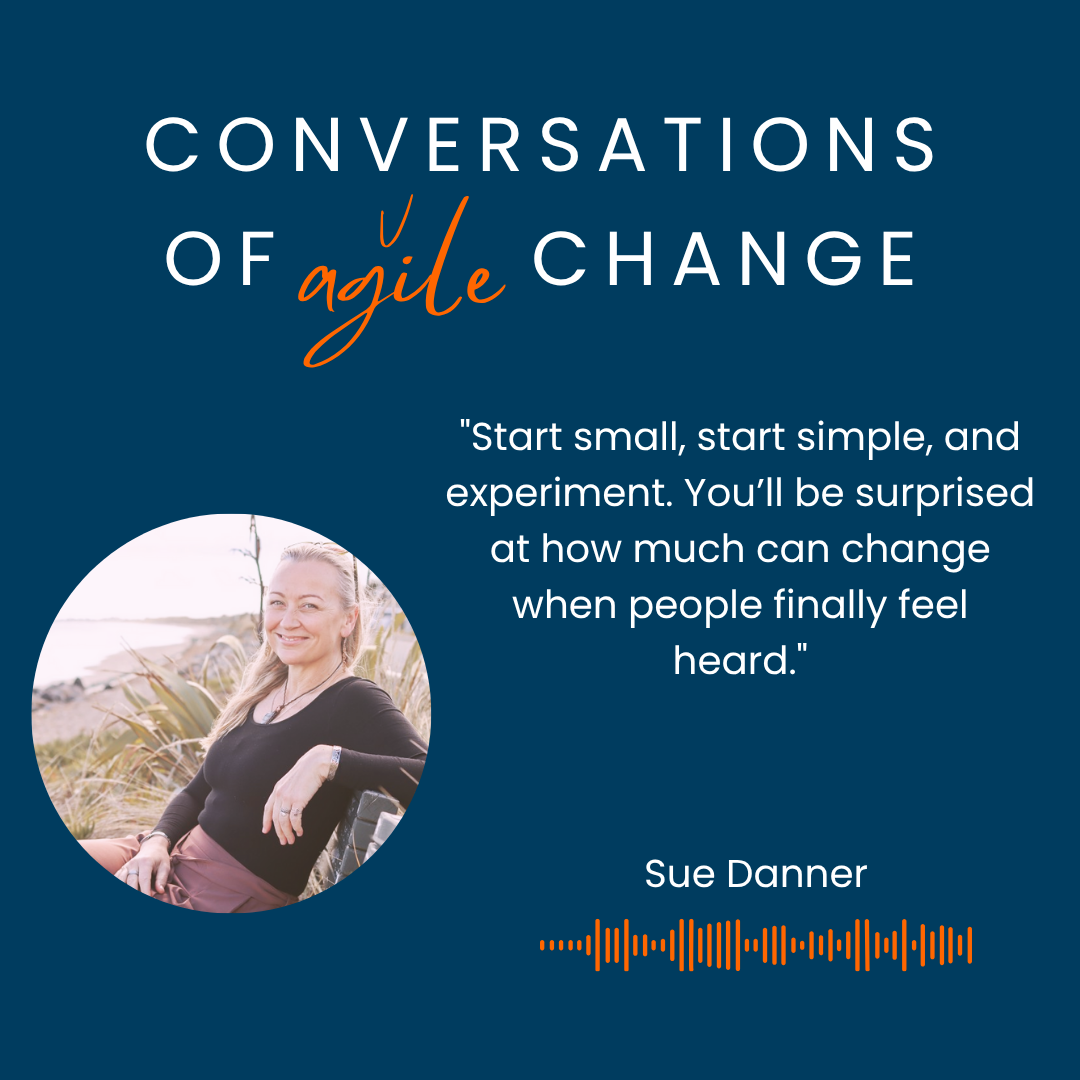
It would be choose something simple. Start small, start simple, and experiment. When I started applying
your principles, practices, and tools, I was in highly-regulated environments and I went too hard, too fast,
and I scared people. It was too much. People didn’t know what I was talking about. I was very
enthusiastic. So start small. Something like the Think, Feel, Do framework is really easy to start with and
you’d be surprised at how well it demonstrates for people a different perspective.
Let me say that again. How well it opens up different perspectives for people. I know when I first used
that, I got these, “Oh,” moments from leaders, “Oh, we hadn’t thought about how people feel.” And then
we have guiding lights of, “Oh, we want our people to feel confident, for example, in a building move.”
our target. And that becomes part of your feedback loop. Where are you sitting with
that? How are we going to measure it?” Exactly. Yeah, nice and easy.
Dr Jen Frahm
That is a awesome piece of advice and I can, again, totally relate to that. And it’s probably something
about when people are new to this space and they get really excited, they can alienate and scare people. I
think that’s a really good example. In the enthusiasm, you forget that what we’re doing is so new to a lot
of people that it can actually distance yourself rather than the opposite, which is what it should do, right,
the engagement. So that’s such, such good advice and I do appreciate it.
Sue Danner:
I might just add a littleSpeaker 2:
At the time of recording… Sorry, you were going to say?
Sue Danner:
I just had a thought. Get your groups around you so you can channel that enthusiasm because you’ve got
to have that outlet because it really does, you do get excited and you’ve got to have that outlet. So stand
those up around you.
Dr Jen Frahm
Again, that’s really wise council because when I think back to the environments and the programs and the
projects where I’ve been really free to go hard from an Agile Change perspective, it’s so much fun. It
makes change management fun again. And you can lose the fun in certain parts of your career in this
space, right? It becomes a bit of a grind and that could actually boost the fun. So that’s awesome. All
righty. At the time of recording, you are on the market. What does great look like in a new role or an
organization? How can the listeners or the viewers help you with your futurespective?
Sue Danner:
Good question. What does great look like? I love being close to operational teams. People have been
asking me about my career objectives, et cetera. Look, I’m just passionate about working directly with
operational teams and helping them elevate. So anything that enables me to do that, I’m very, very happy
to do. And the other thing I would say is I would love to do more not-for-profit work over here. You have
a fantastic not-for-profit sector as well. So I really want to give back, and that’s one of my targets.
Whether I’m doing it paid or unpaid, that actually doesn’t matter.
Dr Jen Frahm
Fabulous. And you are volunteering at the moment for Rethink Change, if I recall correctly. So the
summit in Melbourne coming up in November, you’ve been busy behind the scenes, so thank you for your
service in that. We appreciate you. Sue Danner, it has been a joy and a pleasure. Thank you so much for
your time today on this episode.
Sue Danner:
Thank you so much for having me.
Thanks for joining us on this Conversation of Agile Change. If you are keen for more insights and
inspiration from Dr. Jen Frahm and Lena Ross, you can connect on LinkedIn to stay updated with their
latest thoughts and discoveries. Follow the Agile Change Leadership Institute on LinkedIn or Facebook
for a wealth of valuable resources. Subscribe to our biweekly sprint notes where you’ll find thoughtprovoking content delivered straight to your inbox, or check out @agilechange on Instagram. We look
forward to having you back for more insightful conversations on agile change. Until next time, be brave,
be curious, and have fun with change.