Dr. Jen Frahm:
And welcome back to another episode of Conversations of Agile Change. This week, I am joined by the
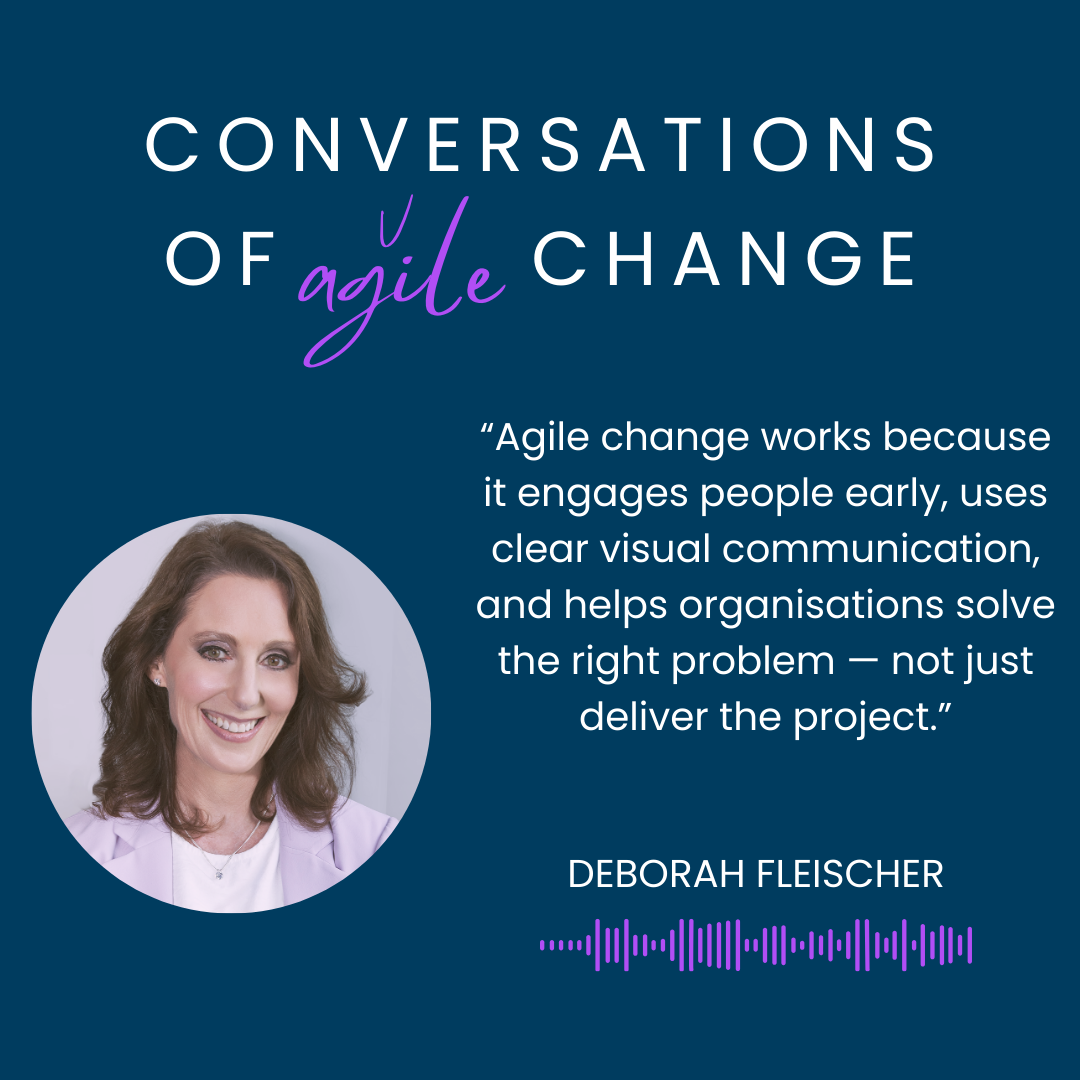
rather fabulous Deborah Fleischer. And by way of explaining the context to this episode, we were having
a chat the other day and she made the incredibly bold assertion that agile change is smoother, better value,
and better quality. And I thought, wait, wait, wait, this is a conversation that I want to record. I think this
is sounding like a podcast. So Deborah, welcome to Conversations of Agile Change.
Deborah:
Thank you, Jen. I’m delighted to be here and I am honored as well to be in such wonderful quality
company.
Dr. Jen Frahm:
Okay, let’s start. So other than an alumni of the Agile Change Manager Certificate Program, who are you?
Tell us a little bit about yourself.
Deborah:
Oh, thank you. It’s a great question. Always love to be asked about ourselves, don’t we? So I am, I guess,
a person who grew up in Melbourne, and my background is really in project and change management,
working across the education and government and financial services spaces. So I’ve done a lot of complex
and enterprise-wide change in various capacities, as well as a project manager, a change manager as well.
And yeah, I really love working to support people to be their best and organizations to work together to
create innovation and to create spaces where people can actually be safe and explore and be curious and
find unique ways to do things to create amazing results.
Dr. Jen Frahm:
That sounds fabulous. That can be such a powerful combination, that background of project management
and change management and having worked in the two spaces, I think just really adds something really
special to practitioners with the way you work. So that’s fabulous. Now let’s get straight to it. Agile
change is smoother, better value, better quality. Tell me what you mean by that.
Deborah:
So in my experience, which is around over 10 years in these complex enterprise-wide changes and
transitioning to become an agile change manager myself, I’ve really noticed that to get change to land,
you really need to engage the people who it’s going to affect and find out from them, what is this change?
What does it mean to you and how can we help you to adopt it? And when I’ve used agile approaches,
agile mindsets, and agile methodologies, both within agile and traditional waterfall environments, I’ve
really found that that engagement and the use of the simple brain-friendly visual communications,
storytelling, and giving people license to really participate in the design of the change makes just an enormous difference to the outcomes that people are able to support in terms of behavior change to make
project outcomes come to life.
Dr. Jen Frahm:
I can relate to that. And what I’m kind of struck by, I feel like sometimes there’s two pathways to working
in agile change. It’s one, we’ve got the opportunity to do it. So the experiences that you’ve just talked
about and do the continuous engagement and visual and transparent, and life is just sweeter and easier, or
we’re in a really frustrating position where we can’t use that approach and things are challenged. Does that
resonate with your experience? Is that where you’ve been in both sides of you can’t use it and you can use
it?
Deborah:
So I think my approach, because I have a really strong growth mindset approach to life, I always look at
challenging environments and think, what is it that is within my control or agency to make a difference
to? So when I’ve been in environments where let’s say there’s sort of a low change maturity and people are
still in that space of like, okay, either what is change management or what’s the value of change
management? We just need to get on with these technological changes and land them, and that’s all that
matters. I have taken that as a challenge to learn who is this audience that I’m speaking to, and what is it
that I need to understand about them to communicate effectively? Because I have no doubt that agile
change and agile change methods, as in human-centered design methods, can benefit any workplace, and
it’s actually the communication and the integration of those into the way those people think and the way
those people work that allows that to come to life.
So yeah, sometimes it’s harder than others because people are less open to making any changes. That’s the
hardest thing.
Dr. Jen Frahm:
I’m mindful, you’ve got this really rich breadth of experience across industries. So I always like to say I’m
industry agnostic and I see that in your background as well. So superannuation, higher education,
banking, government. Do you see any patterns with respect to that across sectors?
Deborah:
Yeah, a hundred percent. And that’s a great question, Jen, because as we move at speed towards a
continuously changing environment, I think the pattern that I see most is that traditional change
management and methodology and tools and models, all of that is, it’s not time to throw it away, but it’s
time to use the structure of that, but translate it into how do we help this environment adopt to continuous
change and not think that it’s like project by project anymore. It’s a massive trend, and it’s something that
I’m really passionate about helping organizations to support their people to adopt change and to adapt to
change and have a mindset and develop those skills within the organization.
Dr. Jen Frahm:
Yeah. If we dig into those three criteria, when you talk about smoother, I think about experience. So
employee experience, vendor experience, the leadership experience in the organization, how does that
impact delivery across those groups? Or is that where you’re seeing smoother or have I jumped to an
assumption there or how do you see smoother playing out?
Deborah:
Yeah, so I think smoother, the reason I made this bold statement was because I think that it applies across
the board. Smoother, I’ve seen agile change approach help communication with leaders, help leaders have
a data informed landscape, laying out what are the impacts and how are people feeling about the change
in a way that it can be done on one page and they can absorb that information much more quickly and
simply to be informed and to work out how they are going to help their people adopt to change. And then
in terms of teams, so let’s say delivery teams, I’ve seen in my work, I’ve actually gone into, let’s say, a
large and complex design of a new operating model, for example. So we’ve got a lot of different experts
in the project team who are wanting to do their own thing. “I’m expert in this.
I’m expert in this. “And as the change manager, I’ve actually come in and said,” Look, we need to get on
the same page and have a shared vision of what problem we have and what problem we’re trying to solve
together in order to work together to land this in a way that’s going to work smoothly for us and for the
organization. “And I just got fantastic feedback throughout that project, we revisited that as a group, we
need to sit down together and think about this together and talk with each other about what our plans are
so that we’re not overstepping on each other and doubling up, but also we are designing something that
compliments itself and works smoothly. So that’s impacted that delivery team a lot.
Dr. Jen Frahm:
Yeah, great example because for me, that’s really a story of alignment, the continuous engagement that we
do, not just with the stakeholders, but within our project team. I’m curious around what do you do early
that prevents friction later? So what is the antecedents to, sorry, the precedence to a smooth experience?
Deborah:
Yeah. So I think just feeding off that example, that using agile methods, which are about collaboration,
knowing who is in the team and what their strengths are, and then creating the relationships to be safe
enough to talk to each other and ask each other for help if you need it, but also how you can help one
another. And so in my approach, I always attempt to get teams to sit down together and get to know each
other a little bit at the start because when I am struggling with something that’s really time sensitive and
it’s, let’s say, high profile, I want to know who I’ve got in the team so that I can talk to them and I want to
know that they’ve got my back and I need them to know that I’ve got their back. And so it’s setting up, for
example, inside the team for success at the start, before you dive into deliverables and schedules and that
sort of thing.
Dr. Jen Frahm:
Yeah. Got it. What role does visibility play? So I’m thinking about dashboards, readiness, heat maps,
shared tracking within the team. How does that play out in your world?
Deborah:
So I would say that one of the things that I love the most and has totally transformed my communication
is the agile change tools that you’ve mentioned where I would never, in my wildest nightmares, go with a
spreadsheet into a meeting to try to explain where we are or what we need to do. Of course, that sort of
level of dotting your I’s and your Ts in the background should go on. But I found across the board with
leaders, with delivery teams and with impacted teams, having really simple, clear communications that
are engaging and express things visually is so much more helpful to conversations and getting people to
engage, getting people to understand, getting people to give feedback and input into a project, just having
those visual tools is critical and that they express data that my work has brought out that’s relevant to the
environment is critical and incredibly involved in my bold statement about the smoothness and the
improved outcomes.
Dr. Jen Frahm:
Well, I couldn’t agree more with that. I think the use of visual tools has completely transformed my
practice as a change practitioner, like night and day, such a difference with it. I am mindful though, the
flip side of the fabulous change practitioner using all the great tools and engaging early and creating the
psychological safety is of course the impact of the leader. So I’m curious what your experience has been
or how you see the leader’s accountability for making a change process smooth. Where does that fit in?
Are there behaviors that support it or get in the way? What’s your thinking about that?
Deborah:
So I think that you’ve sort of hit the nail here on the head, Jen, which is that one of the biggest trip-ups for
success in change programs is lack of leadership or lack of effective change-friendly leadership. And so
as a change manager, I always, always have to be mindful that I am not in the spotlight. I am there to
support the leader and to coach them, to help them understand how to basically how people go through
change, what freaks people out about change, and what freaks different people out about change, because
people go through change differently, and then to help them think through how they’re going to lead
people to increase the change capability, increase the resilience. Because these days in this, I guess, the
world of work that we live in that’s not going to slow down, what’s happening is that there is a rapid
continuous change and you barely land one change project and people haven’t quite settled with that when
they have another change to deal with.
And so personally, as a change professional, it’s digging deep and understanding that there are behavioral
and deeply human elements to change that is very complimentary to all of the AI and analysis that we can
do today, but it’s really helping leaders to understand behavioral change and those sort of deeply human
primal fears that are triggered with this continuous change so that they can help people to become adapt
professionals, professional app being adaptive.
Dr. Jen Frahm:
Right. Well, I think we can tick smoother. Let’s have a look at better value. Now, often better value is
used as a euphemism for cheap, you’re looking for the cheaper thing. Is that the case? Are you saying that
agile change we can cut corners or how does that play out for you? What’s value?
Deborah:
Yeah, so what is value? It’s a great question. And in terms of cheap, always looking for cheaper, I think if
we’re honest, you open the kimono of the boardroom and that’s what they’re looking for. They need to
make things cheaper. And that’s why I brought this up because in order for change to be relevant, we have
to speak to the leaders of organizations who need to address financial bottom line concerns. And so the
thing that I absolutely love and am so passionate about with Agile Change is that in the past you’ve had
these sort of programs of change that the change manager designs for others based on a whole series of
methods and tools that have to go in process. Whereas the agile methodology is much more aligned with
my personality. My partner calls me MacGyver because I’m able to pick out elements to solve a problem
that will actually solve that problem and weed out the things that would be nice, but are not actually
necessary.
And so when I speak about it being cheaper or greater value, what I mean is that you are going to get
better bang for buck with an agile change approach than you are with the traditional waterfall approach in
just every single way.
Dr. Jen Frahm:
And I imagine you’ve had these hallway conversations with the CFOs in the organization and they’re like,
“Well, why should we invest in change?” What’s your go- to answer on that?
Deborah:
Well, whatever change you’re looking at, if people and what people do is going to affect whether this
change is successful or not, if you don’t invest in change, you can have the greatest and smoothest and
most modern technological solution. But if people don’t know how to use it, you’re not going to get the
output that you want. You’re not going to get to the outcomes that you need. And so you need to teach
people and you need people to learn, more importantly, to adopt whatever the change is. And if you don’t,
it’s just not going to land. And there are many statistics that can be shown about adoption being just an
absolute key thing if there’s anything to do, if this change means that people need to do things differently.
Dr. Jen Frahm:
The question I always like to put back at the CFO is, what percentage of your benefits are dependent on
people using this change or adopting this change, getting them to quantify and go, “Well, it’s 100% or it’s
90%.” And I was like, “Well.”
Deborah:
And then I was just going to say, then you can actually go, well, how much money have you spent on this
system? And if a hundred percent of people are only going to adopt it at 50%, you’ve lost that much value
in your ROI.
Dr. Jen Frahm:
Yeah. Yeah. But I do think to your point, we as a profession need to get a lot better at having those ROI
conversations and be on the front foot with it rather than defensive about it. I think often we get into that
conversation once we’re on the ropes and justify yourself, whereas it probably should be part of an
onboarding conversation where you get really clear about that. 100%. You talked before about involving
stakeholders early and also the project teams. I’m curious about how does involving stakeholders earlier
reduce the downstream cost of change?
Deborah:
So that’s a really great question. So with agile change, it’s about getting to know the environment. So it’s
like an analogy. When you go to a shop, the first thing they’re going to ask you is, you want an outfit to
do what? Is it for home? Is it to go to an event, a black tie event? So you’ve got to know what look you’re
trying to achieve. And that’s the purpose of engaging the stakeholders. In order to understand their world
and how much of a change this is to them, you really have to engage with them and get a feel for, is this
something they believe in? Is this something they want? And then you can start working with them to
help them in ways and let’s say provide an outfit that’s going to suit the event.
Dr. Jen Frahm:
Yeah. My head’s gone to outfits now, but I’ll bring it back. I’ll bring it back, the outfits of the change
practitioner. So let’s put the project manager hat back on and the holy Trinity of time, cost, quality. Let’s
pick up on that third one, the quality. So the initial bold statement about agile change resulting in better
quality. Tell me what quality change looks like to you.
Deborah:
So quality change is relevant change. Quality change is change that people believe in, and quality change
is change that people co-create and co-design with you because then it means in the end, people are much
more engaged and willing to adopt something that they helped to design. And quality change is also about
solving the right problem. And I think that agile change methods help organizations to really define what
their challenge is and what they need help with. And so I think that agile change is much better at doing
that because of the way it goes about that in consultation and collaboration with the business and not just
with leaders, with people at the frontline as well, because that’s often a huge mistake that is made in
change that you just adopt, you just engage with leaders and then you invariably get to the end and there’s
just basic stuff that you haven’t spoken to the business about like, okay, what product is it that we deliver
and what time of year do we deliver that during?
And if you don’t consult with those teams, you could miss certain timings that are absolutely critical to
landing a project on time and to budget.
And similarly, if you miss consulting with frontline teams in terms of how they use a system or what their
process is, the solution that you deliver can just be completely inappropriate, even if it’s a great technical
sort of theoretical solution. It’s
Dr. Jen Frahm:
Just not fit for purpose from their perspective. So the concept of quality can be slippery, it can be
subjective. If we want to make it more objective, how do you measure whether change has truly landed?
So what are the quality metrics for you?
Deborah:
Yeah. So I really like to use an approach called the RIO approach to change. And so it starts from what
we were talking about before, Jen, where you actually come up with a solution that’s fit for purpose, and
then you actually design measures that from the beginning that you identify where are we now, where are
we trying to go and measure progress from now to then throughout the process and not see measurement
as something that you do at the end, because then you’ve missed all your opportunities to adapt and iterate
as you go and make sure that the change really lands. So for me, it’s about using, I guess, data, whether
that comes from people or from systems to track measures that you’ve identified that you can track against
outcomes that you’re looking for.
Dr. Jen Frahm:
You often report into governance forums in your background. I’m curious, is there a go- to in terms of
what good reporting looks like, something that you’ve learned, something that doesn’t work in terms of
governance reporting?
Deborah:
So a hundred percent governance reporting has to be simple on one page and using visual supports to
represent data and to tell the story of the data because it’s always one thing to go, well, this is what the
data says, but there will be key elements in interpreting that data that come out of speaking with the teams
and the people that are measured within that data so that you can actually explain things because you’ll
find, let’s say, if data’s tracking badly and not where we want to go, there might be really important
reasons for that that need to be explained. And yeah, so having visuals on one page that are simple and
then having stories that come from, let’s say, the call face to help leaders understand what those tables and
charts are expressing.
Dr. Jen Frahm:
Yeah. Kind of bring it to life in the room. What does Brene Brown talk about data is … No, storytelling is
data with a soul, that concept, which I think fits. How have you handled the challenge of … And you
hinted at it before when you said that if we don’t come to an understanding that it is continuous change
and thinking about discrete project change, how have you dealt with the challenge of sustainable change?
So six to 12 months after go live, how has that played out for you?
Deborah:
So I think that’s one of the themes that comes up most often with leaders is that sustainable change often
gets overlooked and change managers just plan for their project and don’t think about broader across the
organization or broader across time. And so the way that I have addressed that is to integrate the planning
into the project. So for example, if there is a go live and you have a series of change champions that are
helping to train the team and for the team to learn, I have actually created sort of like heat maps. They’re
like horizon plans where I’ve actually looked forward with the teams and worked out with them, okay, so
you’ve completed the training and you’ve been able to start using the system and we are with go live, but
in a year’s time, what do you want the team to be doing with this system?
And then what planning backwards from that, what is it that we need to do after the go live and between
now and then to help the team get there? And then it’s also about the measurement of that and the tracking
of that over time so that you have goals that you’re working for long-term and that you have some
strategies planned as part of the change program to make sure that that happens once the project is done.
Dr. Jen Frahm:
I imagine that leaders would find that incredibly valuable because I don’t think that that is often done. So I
think to your point, I think a lot of change practitioners see themselves as accountable for the delivery of
their project, whereas that really, what does it look like after I’ve left the organization is a lens that’s not
looked at. What else do leaders value most about your approach?
Deborah:
Ooh, that’s a lovely question. So I mean, I’ve had great feedback on how I use, I guess, visual
communications to communicate with leaders and to provide them with exactly the things that we’ve
mentioned, like that measurement and the focus on ROI from the beginning, and also that focus on the
sustainable change planning so that they have confidence that even if I’m not there, I have integrated into
the planning what it looks like for teams to sustain this change. And also, I’ve had really great feedback
over many years of my impact on building change capability within the leadership so that they understand
what does good change leadership look like and what they need to do personally as leaders to develop, to
not just lead well, but to actually produce leaders as part of their legacy.
Dr. Jen Frahm:
Yeah, I love that. And you know what I love the most? And again, this is a call out to the people listening
or watching this, your ability to actually be really clear around what do people value about you is
important. And you’ve just given a masterclass in that, so well done you. While as we head towards the
end of this, because I think you have comprehensively made the case for agile change is smoother, better
value, better quality in there. Tell me, what problems do you enjoy solving and what does the next chapter
look like for you? Where are you heading?
Deborah:
Oh, thank you, Jen. So for me, the next chapter really looks at opportunities where I get to support that
continuous transformation that’s going on for businesses. So it’s not just being a change manager, I would
say it’s being a transformation leader and partner within a business that really values excellence and that
really values the impact that can have in the world. So bringing something of quality to people and also to
society and broader than that. So yeah, just my passion to work with smart people who are good at what
they do and my ability to support them to do that better is, I guess, what I’m best at and what I thrive
doing and what I love doing. So I’m looking forward to having an impact in transformation programs and
enabling people to become much better at being adaptive and thriving in a world of continuous change,
Jen.
Dr. Jen Frahm:
What a brilliant desire and objective. I fully support you in that. Let’s wrap this up. Let’s finish with
what’s one myth about agile change that you’d love to retire?
Deborah:
Well, I think I referred to it in our chat today, Jen, which is that you don’t have to have an agile
environment to use agile change methods. And so even going into very traditional organizations that have
strong, rigid processes and structures can gain a lot, a lot of value from agile change approaches and
methods.
Dr. Jen Frahm:
Marvelous. And again, I would fully support that. That’s probably not a surprise to the people who are
listening at the moment. Deborah Fleischer, thank you so much for your bolder session and being willing
to jump on a podcast and explore those concepts. For the listeners, if that has resonated for you and there’s
elements there, I will link with Deborah’s LinkedIn profile in the notes. I’m sure, Deborah, you’d be happy
to catch up with anybody. If anybody’s got some of those magical organizations that have the ability for
Deborah to come forward and make a difference in continuous change, then I reckon you’d be pretty
happy to hear from them as well. Deborah. Yeah, thanks for joining us.
Deborah:
Thank you, Jen. Thanks for the opportunity. It’s lovely to chat with you, and I’d love to do it again.
Speaker 1:
Thanks for joining us on this conversation of Agile Change. If you’re keen for more insights and
inspiration from Dr. Jen Fram and Lena Ross, you can connect on LinkedIn to stay updated with their
latest thoughts and discoveries. Follow the Agile Change Leadership Institute on LinkedIn or Facebook
for a wealth of valuable resources. Subscribe to our biweekly sprint notes where you’ll find thoughtprovoking content delivered straight to your inbox or check out @AgileChange on Instagram. We look
forward to having you back for more insightful conversations on Agile Change. Until next time, be brave,
be curious, and have fun with change.