2026 at ACLI: practising what we preach
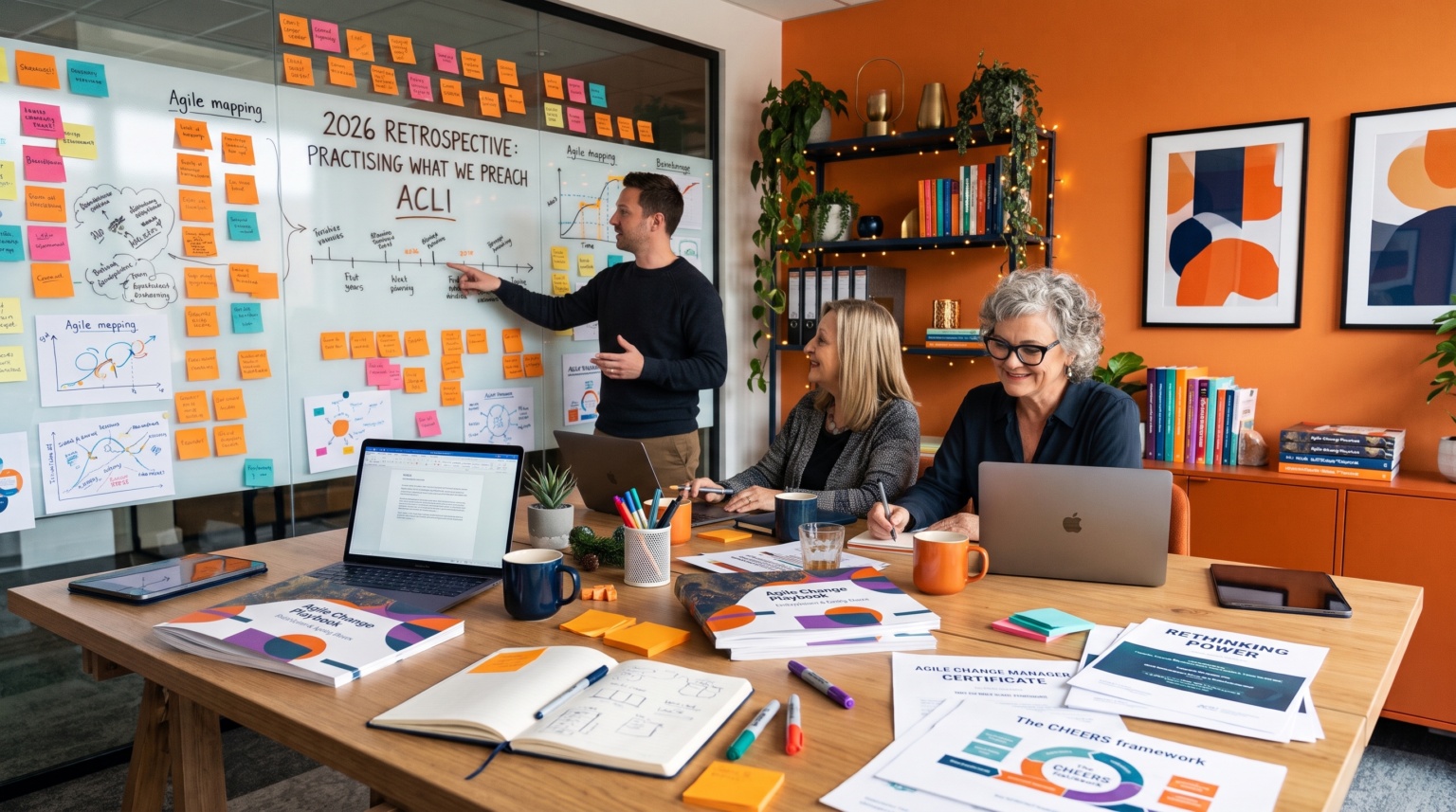
We spend a lot of our working lives telling organisations to inspect and adapt. Run the experiment, look honestly at what it tells you, and change course when the evidence says you should. In 2026 the Agile Change Leadership Institute took its own advice and, as we do every year, we did it publicly.
Five years of the Agile Change Manager Certificate
The Agile Change Manager Certificate turned five this year. Five years is long enough for a program to age quietly, and ours had.
The refresh followed a detailed analysis of learner feedback collected between August 2024 and August 2026. Across 795 completed learner responses, the certificate averaged 9.12/10 for ease of understanding and 8.86/10 for value and usefulness. All five modules performed strongly, and none came up as consistently underperforming. The bones were good. The world around them had moved.
Lena and I gave it a full refresh rather than a polish. The pandemic references came out. The neuroscience was updated and the recommended readings were updated. We added a Sponsor Operating Model, captions for every module for accessibility, a Quick Content Locator so you can find any practice in seconds, and Swap This for That for the moments when the old habit feels easier than the new one.
The biggest addition was a new module on AI and agile change, released in October. It covers why AI change has to be agile, the identity shift people go through when their work changes around them, and a worked example from a real engagement. Learning time grew from 4 hours 30 minutes to 5 hours 15 minutes, about 17% more, and existing alumni get the new module at no extra cost. If you studied with us years ago, the course you did is still growing.
We saw significant growth in our group-coaching version of the certificate: six sessions built on a practise, assess, adapt cycle, ending with each participant shaping their own Minimum Viable Change Process. It reflects something we heard again and again this year. People don’t want more content. They want help applying it.
AI, the brain-friendly way
AI was the conversation of the year. Much of the advice on AI change skips the people it happens to. We tried to do the opposite.
Leading AI Change: The Agile Way brings together a micro-course and a practical toolkit: the AI Hypothesis Canvas, AI Conversation Starters, the Four Pathways Diagnostic and the Levers Success Slider. The Four Pathways began in 2020 as a way of making sense of pandemic change. A good framework travels.
Brain-Friendly Change and its 88 practices grew to over 100 practices and kept reminding us that you cannot build capability in a threat state. Michelle Teunis, Lena Ross and I are taking that into a live masterclass on AI, change and applied neuroscience on 20 January 2027.
Research and resources
We released Rethinking Power: What Every Change Leader Needs to Know. It revisits the classic power frameworks and asks what changes when AI enters the room. Alongside the launch of Change. Communication., we published the Delphi white paper The Future of Change Communication.
On the blog we wrote about why your team is resisting AI (it’s not the tech), about agile practices as relief for cognitively exhausted organisations, and about VUCA, VUCA Prime and BANI.
The Sprint kept arriving every fortnight and reached edition 24 in by end of year.
Most read blog posts
- VUCA, VUCA PRIME & BANI
- CCMP vs Prosci vs ACLI
- 70% of change fails: Bollocks!
- The 100% Dead Dog: A Lesson in Change Leadership, Empathy and Percentages
- Change management buzzword bingo
- Cognitive exhaustion in the workplace: What Change Leaders need to know
- Change Fatigue Revisited
- What is Change Leadership?
- Why your team is resisting AI (it’s not the tech)
- What Is Change Management?
Conversations that kept us honest
- Lena and I ran free webinars on journey mapping, future-state mapping and reframing “resistance”, and on the six shifts in change leadership.
- At ACMP Global Connect in July we presented Learning that Lands: The Neuroscience of Change Capability, built on our CHEERS framework.
- Marco Di Santis and I came back for an encore of Neurodivergent & Agile. The conversation continues in Agile Change: The Dance Party Where the Neurodivergent Find Their Groove after presenting at Agile Australia.
- We spent a session with Young Change Agents on the agile founder mindset. Teenagers have very little trouble shipping the ugly version.
- Conversations of Agile Change turned ten and passed 44,000 lifetime downloads, with a growing focus on our alumni and what agile change looks like on an ordinary Tuesday.
What surprised us
How quickly “current” becomes “dated”. Examples that felt urgent in 2021 read like history now.
And how deeply the neurodivergence work landed. The responses to Neurodivergent & Agile were more personal and more emotional than to anything else we presented this year. That tells us where the conversation needs to go next.
What was harder than expected
The market for professional development shifted under our feet. Part of this was a redirection of budgets to AI training, part of it was global anxiety and exhaustion over the state of the world. When people feel under threat, they don’t always seek to update their skills. Some hide under a metaphorical blanket and we get it. People want shorter formats, applied learning, coaching alongside content, real relevance to AI, and evidence that the learning changes something at work. Self-paced learning on its own asks a lot of a busy person, and we have had to rethink how we support people through it.
Some of our experiments didn’t land the way we hoped. We treated them as data. That’s easy to write in a blog post and less comfortable to do in real time, but it’s the same thing we ask of the organisations we work with.
What I’m proud of
That we refreshed a program people trust, rather than leaving it alone or starting again. That alumni get the new AI module because they’re part of the community, not because they paid twice. That 795 learners took the time to tell us what they thought, and that what they told us was this good. And that ACLI learners now come from 81 countries, more than 3250 people in all.
I’m proud of the impact this work continues to have – there’s not many brands who consistently get such great feedback out there.
Taking into 2027
We opened the year doing what we ask every organisation to do: looking honestly at what’s working and what the world has moved past. We’re closing it with a stronger program, a clearer sense of what learners need now, and a few humbling lessons we’re grateful for.
Into 2027 we’re carrying one simple intention: keep evolving, and keep making change capability practical and human. The world isn’t slowing down for any of us. Better, then, to build the capability to move with it.
If you have the Agile Change Manager Certificate with us, log in and take a look at the new AI module. It’s yours, and we’d love to hear what you make of it.
If you have done the Agile Change Leadership Certificate, don’t forget that was refreshed last year and you can access new content.
If you have done Brain Friendly Change with us, you get a special price for the live webinar with worked examples and new tools.