Project management vs change management: two sides of the transformational coin
Every organisation running a transformation eventually asks the same question. Do we need project management, change management, or both?
Our answer is both, every time. To see why, it helps to be clear on what each one does, where they overlap, and why they can’t be pulled apart.
What change management does
Change management is about adoption.
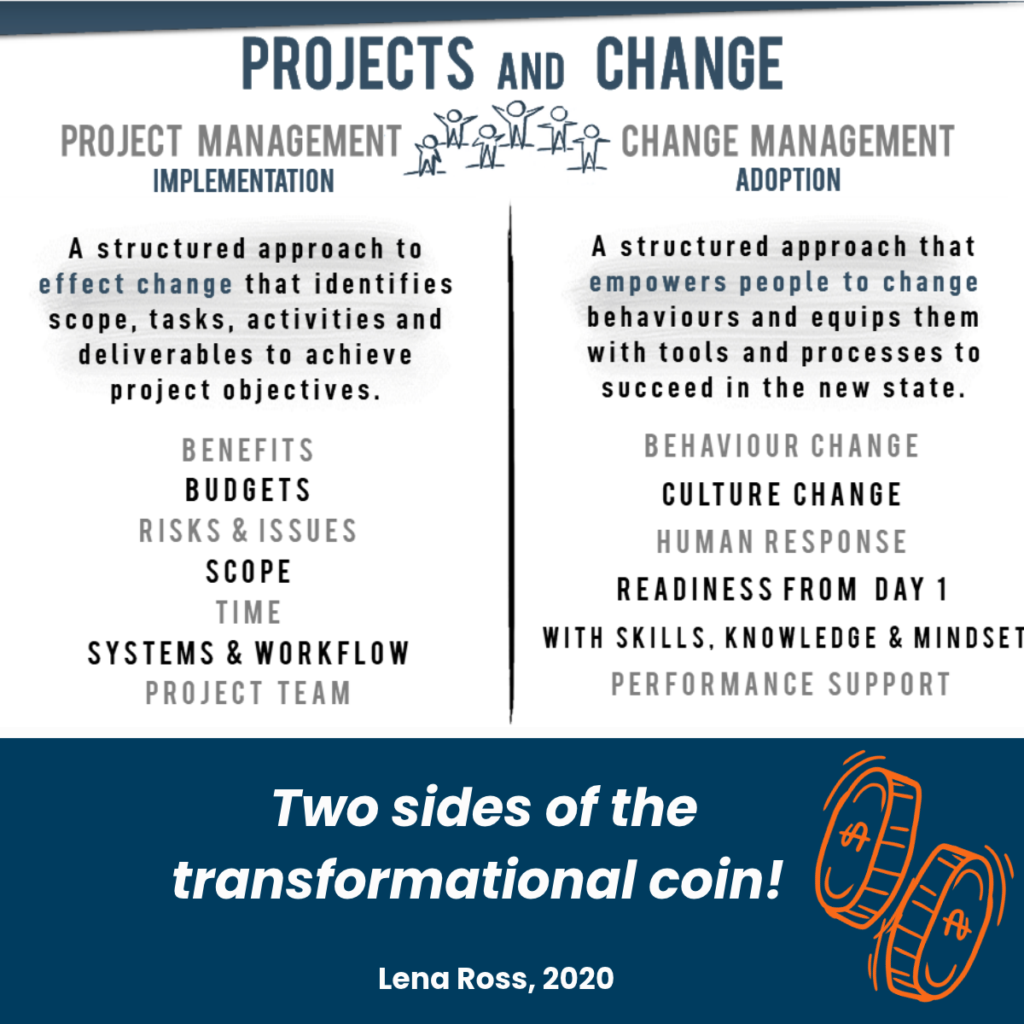
It’s a structured approach that helps people change their behaviour, and equips them with the tools and processes to succeed in the new state.
A change manager’s world includes:
- behaviour change
- culture change
- human response
- readiness from day one
- skills, knowledge and mindset
- performance support
The question change management answers is: will people work in the new way, and keep working that way?
Where they overlap
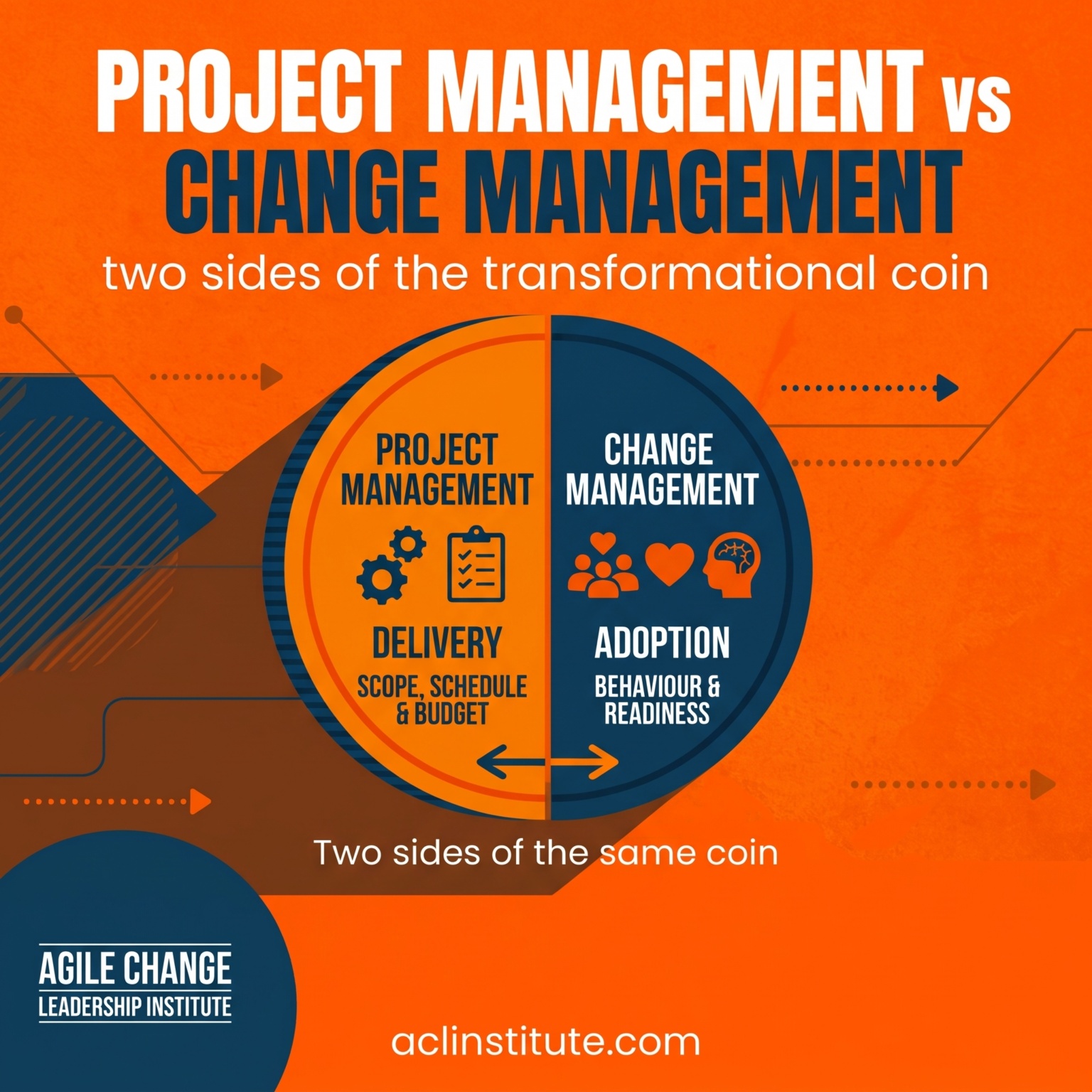
The tile shows a clean split, because that makes the difference easy to see. In practice, the edges overlap a lot.
The skills cross over. Project managers need to understand how people respond to change. Change managers need to work with structure, plans and governance. Neither can be fully effective without understanding the other’s discipline.
Both start at the beginning. Change management isn’t something you add once the solution is chosen. Involving the people affected early helps define the right problem and shape a solution they’ll use. That makes the project plan stronger too.
The project team needs readiness too. The people building the change are often still doing their day jobs, absorbing uncertainty and making decisions under pressure. Their capacity and clarity affect both the quality of what they deliver and how confidently they bring others along. Supporting them is a project responsibility and a change responsibility.
Success goes beyond go-live. Go-live is where adoption begins. The plan needs delivery measures and adoption measures, with someone accountable for both.
An integrated approach multiplies the value
Having both disciplines on a project is a good start. The value multiplies when they work as one.
In Change Management: The Essentials, Lena Ross looks at the different ways project managers and change managers work together. The ideal is the integrated approach, where the two work closely together. It looks like this:
- Respect for each other’s roles and responsibilities. Each knows what the other is there to do, and values it.
- A shared understanding of how the two disciplines support each other. Neither works in isolation.
- Clarity on who does what. Everyone knows which activities each person owns, and which ones you carry out together.
That doesn’t happen by accident. The best way to make it happen is a conversation early in the project or initiative, before plans are locked in, where you build an aligned roadmap together and agree where the overlap (the mutual support) sits.
Start with an aligned roadmap
An aligned roadmap is a great way to open the discussion between project manager and change manager. It gives role clarity, and helps you agree the key activities and the areas you’re jointly accountable for.
Here’s a simple starting point for that conversation. It’s an example only, and doesn’t cover every activity or responsibility of either discipline.
Area | Who leads | How the other contributes |
|---|---|---|
Defining the problem | Shared | Both, before the solution is locked in |
Scope, schedule and budget | Project management | Change brings data on readiness and change load |
Impacts and readiness | Change management | Project builds the activity into the plan and budget |
Project team capacity | Shared | Project resources the team; change supports their readiness |
Success measures | Shared | Delivery and adoption, tracked past go-live |
Notice how many rows say “shared”. That’s where the integrated approach does its work.
Why they can’t be separated
This is why we call them two sides of the transformational coin.
Heads and tails face different directions, but they make up one coin with one value. You can’t spend one side on its own.
Project management and change management look at a transformation from different angles, but they serve the same outcome. Deliver a solution nobody adopts, and the investment is wasted. Prepare people for a change that never arrives in working order, and the effort goes nowhere.
Fund only one side, and you won’t get much for your money. Integrate them, and you get far more than the sum of the parts.
Feel free to use Lena’s tile when you’re making the case for the change resources you need.
Want to go deeper?
Lena’s book Change Management: The Essentials covers the integrated approach in detail, along with the theory and models behind change practice, the different types of change programs, and practical models and templates throughout.
As one reader put it on Amazon, it’s “to change managers what primer is to paint”.
Short, readable chapters. A solid base for new practitioners, and a handy refresher for experienced ones.
📘 Get your copy: https://aclinstitute.com/books/change-management-the-essentials/
Frequently asked questions
What is the difference between project management and change management?
Project management focuses on implementation: the scope, tasks, budget, schedule and deliverables needed to build and deliver a solution. Change management focuses on adoption: helping people change their behaviour and giving them the skills, knowledge and support to succeed in the new state.
Which is more important, project management or change management?
Neither works without the other. A delivered solution that nobody uses produces little value, and change management needs a well-run project to give people something stable to adopt.
What does “two sides of the transformational coin” mean?
It means project management and change management are different views of the same transformation. Like the two sides of a coin, they can’t be separated without losing the value.
What is an integrated approach to project and change management?
It’s where the project manager and change manager work closely together, with respect for each other’s roles and a shared understanding of how the two disciplines support each other. It gives clarity on who is responsible for what, and which activities are carried out together.
How do project managers and change managers agree who does what?
Hold a discussion early in the project and build an aligned roadmap together. Map the key activities for each discipline, agree where they overlap, and agree which areas you are jointly accountable for.
Can a project manager do change management?
On smaller initiatives, often yes, as long as they have change capability and time set aside for it. On larger or more complex changes, a dedicated change role usually pays off. Either way, each discipline works best when it understands the other.
When should change management start?
At the start of the project, before the solution is locked in. Involving the people affected early helps solve the right problem and builds commitment, not just compliance.
Does change management end at go-live?
No. Go-live is where adoption begins. Change management continues afterwards through reinforcement, performance support and tracking whether people are working in the new way.